

MKB Juristen drafts custom legal documents
It is best not to cobble together or copy important contracts, terms and conditions, and other legal documents yourself. We help entrepreneurs on a budget with customized legal solutions, clear costs upfront, and practical explanations.
- Custom contracts, terms and conditions, and legal documents
- Budget-friendly and clear about the costs upfront
- Request a free consultation or a no-obligation quote
Did you know that a minor oversight when drafting a settlement agreement can land you before the sub-district court years later, even if you thought everything was legally in order? As an entrepreneur, you want to conclude an employment relationship professionally and definitively, without costly claims landing on your desk afterwards. It is understandable that you dread the complexity of dismissal law, the calculation of the transition payment, or the fear of a claim that unexpectedly falls outside the final discharge.
With this comprehensive guide and practical checklist, you can draft a legally watertight agreement that minimizes risks and creates peace of mind for both parties. You gain the assurance that the employee can no longer file claims and that the arrangements meet the UWV requirements for a secure unemployment benefit, avoiding unnecessary friction. In this article, we walk through all crucial steps, from the statutory 14-day cooling-off period to the current rules regarding the transition payment, which will amount to a maximum of €102,000 in 2026. This allows you to conclude the employment relationship flawlessly and keep your focus on your own business operations.
Key Points
- Discover how you can prevent future claims and achieve full final discharge with a legally watertight structure.
- Learn why a neutral wording of the reason for dismissal is essential to secure your employee's right to unemployment benefits.
- Use our practical checklist for drafting a settlement agreement to ensure you never overlook crucial details such as the fictitious notice period.
- Gain insight into the biggest pitfalls, such as entering into an agreement during illness and the consequences for the prohibition on termination.
- Follow a clear step-by-step plan to move from an initial factual investigation to a professional termination of employment.
What is a settlement agreement and why is a good draft crucial?
Terminating an employment relationship is rarely a pleasant process, but it is a business reality that every entrepreneur will face sooner or later. What exactly is a settlement agreement? At its core, it is a contract in which you and your employee jointly agree on the termination of employment. We call this termination by mutual consent. The major advantage of this is that you completely bypass the process at the UWV (Dutch Unemployment Insurance Agency) or the subdistrict court. Drafting a carefully considered settlement agreement not only saves you months of legal wrangling but also prevents you from getting bogged down in the rigid rules and unpredictable outcomes of a formal dismissal procedure. While a procedure at the UWV often revolves around strict, almost impossible burdens of proof regarding business economic reasons, a settlement agreement offers you the necessary room to reach a pragmatic solution through mutual consultation that is acceptable to both parties. It serves as an essential risk management tool that protects your company against future claims.
When do you opt for a settlement agreement?
You usually choose this route for business economic reasons, such as a reorganization, or when there is an irreparably disrupted employment relationship. It is an effective way to keep control over the process and costs. However, you cannot simply put a proposal on the table out of the blue. A flawless settlement begins with building a solid case file for the employer's dismissal. Without solid substantiation, you are simply in a weak position in negotiations, and an employee will be less inclined to sign. Do note the limitations. For example, a settlement agreement is unsuitable in the case of summary dismissal due to urgent reasons. In those extreme situations, the legal context is completely different, and a settlement via a settlement agreement often entails unnecessary risks for your own legal position and reputation.
The legal status of the termination agreement
A signed settlement agreement has what legal experts call 'compelling evidential value'. This means that the agreements put in writing are, in principle, binding and cannot simply be set aside by a judge. Therefore, accurate written documentation in accordance with Dutch law is an absolute requirement. It provides you with the much-needed certainty that you will not be faced with unexpected wage claims or other demands after the agreed end date. However, always take into account the employee's statutory right of withdrawal. After signing, the employee has 14 days to withdraw their consent in writing without giving a reason. If you do not inform the employee of this explicitly and in writing in the text, this period is automatically extended to 21 days. Drafting a professional settlement agreement therefore requires constant vigilance regarding these crucial legal deadlines and formal requirements.
The essential components of a watertight settlement agreement
When drafting a settlement agreement is on your agenda, a standard template is rarely sufficient. You need precision to prevent future disputes. The most critical part is the description of the reason for dismissal. To safeguard your employee's entitlement to unemployment benefits, the agreement must explicitly state that the initiative for termination lies with you as the employer. It must also state that there is no urgent cause for dismissal. A neutral wording, such as an 'irreconcilable difference of opinion regarding the interpretation of the position', is often the safest choice to avoid friction and secure the employee's cooperation.
Additionally, do not forget the notice period. The UWV applies a notional notice period based on the duration of employment. This varies from one month for a contract shorter than five years to four months for employment of fifteen years or longer. If you choose an end date that falls before the expiration of this period, the employee will not receive benefits for the intervening period. This often leads to a refusal to sign or to difficult negotiations afterwards. It is therefore essential to carefully align the end date with the legal framework.
Financial settlement and compensation
Integrating the correct compensation is a standard part of the process. In 2026, the maximum statutory transition payment amounts to €102,000 gross, or one year's salary if that is higher. It is advisable to use an expert tool to calculate the employer's transition payment to avoid errors in the calculation. In addition to this severance pay, you must make clear agreements regarding the payment or use of remaining vacation days and holiday pay. Also, specify the latest date by which company property such as a laptop, phone, or lease car must be returned. This prevents you from having to chase after your belongings after the end date.
Post-contractual clauses and confidentiality
Existing agreements in the employment contract do not automatically lapse. You must explicitly decide whether to maintain the non-compete clause or drop it. Do you want to protect your client base and revenue? Then drafting a specific non-solicitation clause essential for the employer in the settlement agreement. Combine this with a confidentiality clause regarding the content of the agreement and sensitive trade secrets. Agreements regarding a neutral or positive testimonial and references also help to conclude the process constructively. Do you want to be sure that your draft contains no loopholes? A quick legal check of your documents will prevent costly mistakes in the future.
Finally, the clause regarding final discharge forms the cornerstone of the agreement. With this, both parties declare that, after the execution of all agreements made, they have no further claims against each other. This is your guarantee that the case will truly remain closed. Drafting a careful settlement agreement means placing each of these building blocks precisely in its proper place.
Pitfalls when drafting a settlement agreement for SMEs yourself
Drafting a settlement agreement yourself seems, at first glance, an efficient way to close a case. However, the details harbor risks that immediately negate any savings on legal costs. One of the most common mistakes is simply forgetting to include the statutory 14-day cooling-off period in the text. If this right of withdrawal is not explicitly mentioned, the employee is automatically granted 21 days to reconsider the decision without providing a reason. This unnecessarily prolongs your uncertainty. Unclear wording regarding final discharge is also a known pitfall. If you do not specify exactly which claims have been settled, an employee may still come knocking later for outstanding overtime or a thirteenth-month bonus that you thought you had bought out.
Risks related to illness and reintegration
The greatest danger regarding termination by mutual consent lies with sick employees. The prohibition against dismissal during illness is almost sacrosanct in Dutch employment law. Does an employee sign a settlement agreement while officially ill? In most cases, the UWV (Dutch Social Security Agency) will then refuse benefits because the employee has become 'culpably unemployed' by giving up their own protection. For you as an employer, this can lead to a wage penalty or a claim for poor employership. In the event of illness, a settlement agreement is actually only a safe option after the statutory period of 104 weeks of continued wage payment. Because the line between 'not feeling well' and official incapacity for work is sometimes blurred, it is advisable to legal advice regarding employment law for employers . This prevents a seemingly simple solution from escalating into a protracted procedure.
Errors in the notice period and termination date
Another costly mistake is incorrectly calculating the notice period. The clock only starts ticking from the moment the agreement is definitively signed, not from the moment of the first meeting. If you let the employee go too early without respecting the UWV's fictitious notice period, a gap arises in the employee's income. Often, the employee will then demand that you compensate for this difference through a higher severance payment. Also, make a conscious choice between continuing to work until the end date or a complete exemption from work. With an exemption from work, the employee retains their salary without having to be present. This creates stability in the workplace, but ensure that you arrange matters such as the return of company property and the transfer of duties before the actual exemption. Drafting a sloppy settlement agreement almost always leads to unwanted financial surprises at the end of the process.
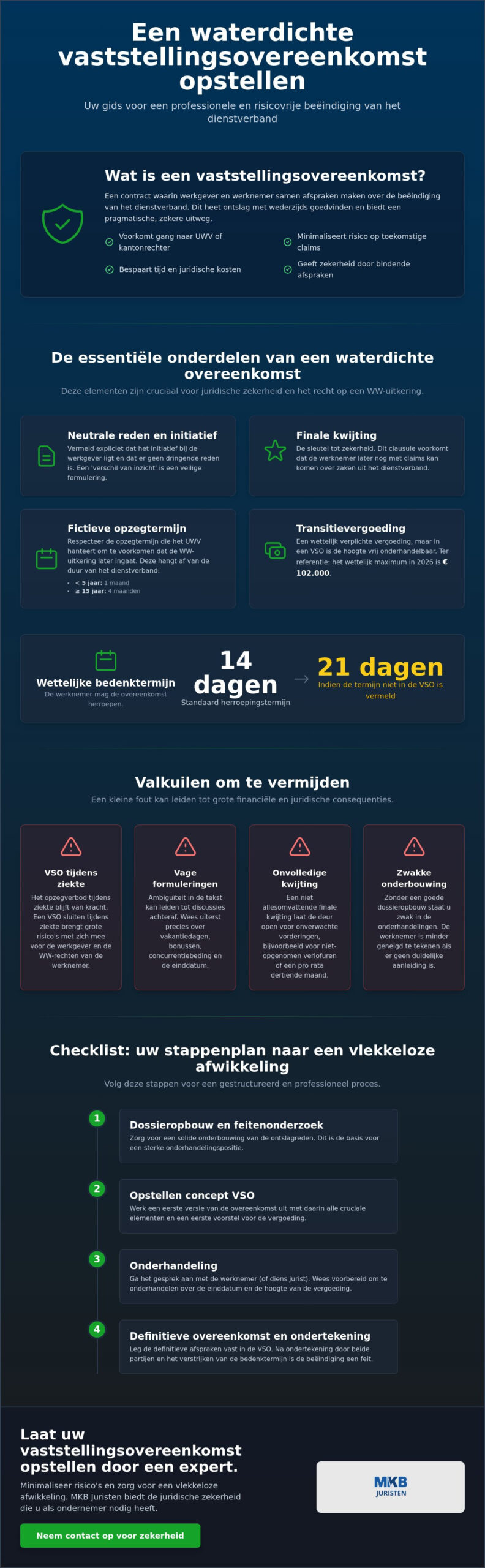
Checklist: drafting a settlement agreement step-by-step
To ensure a flawless termination of employment, a structured approach works best. Drafting a settlement agreement is a process in which you cannot overlook a single detail. Use this step-by-step plan to maintain control and minimize legal risks:
- Step 1: Inventory the facts and check the notice period. Verify exactly how long the employee has been employed. Based on this, determine the statutory notice period (ranging from 1 to 4 months). Take into account the UWV's notional notice period to avoid jeopardizing unemployment benefit rights.
- Step 2: Formulate a neutral proposal for termination. State that the initiative lies with you and that there is no urgent reason. Use a neutral term such as a 'difference of opinion'.
- Step 3: Process all financial components and stipulations. Include the transition payment and make agreements regarding the final settlement of vacation days, bonuses, and holiday pay.
- Step 4: Check unemployment benefit safety for the employee. Verify that the text explicitly states that summary dismissal is not applicable. This prevents unnecessary friction during the negotiations.
- Step 5: Have the settlement agreement definitively checked by a lawyer. Even a minor typo in a date can have major financial consequences.
Preparation for the interview
Good preparation is half the battle. Always confirm your proposal in writing to the employee after explaining it verbally. In practice, it is common to advise the employee to seek legal assistance to have the agreement reviewed. As an employer, you often cover part of these costs, which increases the willingness to sign. Do not forget to clearly include the statutory cooling-off period of 14 days in the text. If you fail to do so, this period is automatically extended to 21 days, leaving you in uncertainty for longer.
The final check before signing
Before you and the employee sign, perform a final thorough check. Verify that all pages have been initialed by both parties to prevent later disputes regarding the content. Also, verify that the signing date aligns logically with the chosen end date and the notice period. Do you want to be 100% certain that your document is legally sound? Then use the ContractCheck™ from MKB Juristen. This ensures that drafting your settlement agreement results in a safe and definitive solution for your company.
Why MKB Juristen is the right partner for your dismissal case
When an employment contract is terminated, a great deal is at stake for you as an entrepreneur. You are not looking for theoretical treatises on employment law, but for a partner who understands how daily practice works in small and medium-sized enterprises. We speak your language and employ a down-to-earth, transparent approach. Drafting a professional settlement agreement requires more than just filling in a template; it demands a keen eye for the specific risks within your organization. Our legal experts specialize in the corporate market and know exactly how to close a case as efficiently as possible. This limits the damage and allows you to focus fully on your core business again.
Our pragmatic approach means that we look not only at the letter of the law, but also at the practical feasibility of an arrangement. We understand that speed is often essential to maintain calm in the workplace and prevent further escalation. Thanks to our years of experience with entrepreneurs in various sectors, we know exactly where the legal pain points lie and how to proactively address them. This creates a sense of calm and predictability during what is often an uncertain period.
Our services for employers
We offer various forms of support tailored to the stage your dismissal file is in. Do you want a watertight agreement drafted from the ground up? We handle the entire process of drafting custom settlement agreement, taking into account all post-contractual clauses and financial settlements discussed in the previous chapters. Do you already have a draft ready but are unsure about the details? With our ContractCheck™, we conduct a thorough analysis of your existing documents to close any gaps in the final discharge or errors in the notice period. Additionally, you can turn to us for comprehensive employer advice on dismissal procedures, where we guide you from the initial file preparation to the final signing.
Immediate certainty regarding your settlement agreement
Using a standard template from the internet is one of the biggest risks you can take as an employer. Such templates never cover the specific risks of your company and do not take into account the most recent legislative changes or the current transition payment amounts for 2026. We help you conclude the relationship with your employee in a professional and respectful manner, minimizing the risk of costly claims afterwards. The ContractCheck™ was specifically developed for entrepreneurs who need a quick second opinion before making a final proposal. It gives you the certainty needed to complete a dismissal process without legal repercussions. Our approach focuses on preventing proceedings before the sub-district court through preventive advice and rock-solid contracts. Do you want to know immediately where you stand in your specific situation? Then contact us for a no-obligation initial consultation and discover how we can unburden you.
Finalizing your dismissal file securely and definitively
Drafting a professional settlement agreement is the only way to terminate an employment relationship without legal repercussions. You now have the tools to formulate the reason for dismissal in a way that aligns with unemployment benefit regulations, correctly apply the fictitious notice period, and secure a watertight final discharge. This prevents you from being confronted with unexpected claims or costly proceedings before the subdistrict court afterwards. It is an essential investment in risk management that pays for itself immediately in terms of peace of mind and continuity for your business.
Do you want the absolute certainty of a document written specifically for your unique situation? Since 2009, MKB Juristen has been the leading specialist in employment law for employers. We understand that you do not need complicated jargon, but rather a down-to-earth approach and transparent rates. Have your settlement agreement drafted or reviewed by MKB Juristen and choose the expertise of a partner who stands by your side. This way, you professionally close the chapter on the past and can focus on the future and the growth of your business with peace of mind.
Frequently asked questions about the settlement agreement
What is the minimum notice period for a settlement agreement?
The notice period for a voluntary settlement agreement is equal to the statutory notice period that applies to you as an employer. This period amounts to one month for employment of less than five years and increases to four months for a contract of fifteen years or longer. It is crucial to strictly adhere to this period, as the UWV applies a fictitious notice period. The employee only receives benefits after this period has fully expired, which can lead to wage claims if an incorrect date is used.
Is an employee always entitled to unemployment benefits after signing a settlement agreement?
An employee is only entitled to unemployment benefits if the agreement meets specific legal conditions. For example, the text must clearly state that the initiative for the termination lies with the employer and that there is no urgent cause for dismissal. The correct notice period must also have been observed. If the employee takes the initiative themselves or is unemployed through their own fault, the UWV will refuse the benefit in most cases.
Do I have to pay a transition payment by mutual agreement?
Legally speaking, you are not legally obliged to pay a transition payment in the case of termination by mutual agreement, but in practice, this is almost always a standard part of the negotiations. The employee will rarely agree to a termination without financial compensation that is at least equal to the statutory standard. In 2026, the maximum transition payment was set at €102,000 gross, or one year's salary if the employee earns more than this amount.
Can an employee revoke the settlement agreement after signing it?
Yes, after signing, an employee has a statutory cooling-off period of 14 days to revoke the agreement in writing without giving a reason. If you do not inform the employee of this right in writing in the agreement itself, this period is automatically extended to 21 days. Drafting a settlement agreement therefore always requires the inclusion of this specific revocation clause to keep the period of uncertainty for you as an entrepreneur as short as possible.
What happens if I enter into a settlement agreement with a sick employee?
Entering into a settlement agreement with a sick employee is highly risky due to the statutory prohibition on termination during the first two years of illness. By doing so, the employee forfeits their right to sickness or unemployment benefits, as the UWV views this as an act of detriment. This can lead to the employee annulling the agreement or holding you liable for the missed benefits. Only do this after specific advice or when the employee has already been ill for more than 104 weeks.
Is a final discharge in special secondary education truly definitive?
A well-formulated final discharge ensures that neither party has any further claims against the other after the final settlement. In principle, this is final, provided that all agreements made, such as the payment of accrued vacation days and the transition payment, have been fully executed. Claims falling outside the scope of the agreement or deliberately withheld may, in exceptional cases, still lead to legal disputes. Therefore, ensure a very precise list of all items.
What is the difference between a termination agreement and a settlement agreement?
In daily practice, these terms are often used interchangeably for termination by mutual consent. Legally speaking, a settlement agreement is a specific contract form under the Civil Code intended to definitively resolve uncertainty or disputes. The settlement agreement offers you the greatest legal certainty because the agreements carry binding evidential value. This makes it the standard choice for entrepreneurs who wish to conclude an employment relationship professionally and without the risk of future claims.
Why should I hire a lawyer to draft a settlement agreement?
Engaging a legal expert helps you avoid costly mistakes regarding unemployment benefit security and the fictitious notice period. An expert ensures a contract that perfectly matches your business situation, which is simply not possible with a standard template from the internet. By the drafting of a settlement agreement to a specialist, you can be certain that the case remains permanently closed. In the long run, this saves you a great deal of time, money, and frustration regarding potential proceedings before the subdistrict court.




