

MKB Juristen drafts custom legal documents
It is best not to cobble together or copy important contracts, terms and conditions, and other legal documents yourself. We help entrepreneurs on a budget with customized legal solutions, clear costs upfront, and practical explanations.
- Custom contracts, terms and conditions, and legal documents
- Budget-friendly and clear about the costs upfront
- Request a free consultation or a no-obligation quote
What happens to your carefully built client base if your most experienced employee decides to leave? For many entrepreneurs, the fear of revenue loss due to switching clients is a daily reality, especially now that judges are scrutinizing standard contracts full of unreadable legal jargon more and more critically. In 2026, drafting an employer-contract non-compete clause is no longer a matter of simply copying a template. It requires a strategic approach specifically tailored to your unique business structure and current case law.
We understand that you value peace of mind and predictability within your personnel policy. That is why, in this article, you will discover how to draft a legally watertight non-solicitation clause that protects your valuable business relationships without incurring unnecessary risks. We provide a clear overview of the rules in 2026, explain why a non-solicitation clause is often more effective than a broad non-competition clause, and show you how to create a contract that actually offers protection in court. This way, you know exactly where you stand and your revenue remains secure.
Key Points
- Learn why a non-compete clause is essential for protecting your goodwill and how to effectively distinguish between active and passive customer contact.
- Discover the strict legal requirements for 2026, such as the heightened duty to provide reasons that applies when including clauses in temporary employment contracts.
- Avoid costly pitfalls by specifically defining relationships and learn why adding prospects is crucial for full revenue protection.
- Follow our practical step-by-step plan for drafting an employer non-compete clause to legally and correctly formulate the exact compelling business interests for each position.
- Understand why standard templates are risky and how custom work from MKB Juristen ensures a contract that actually stands up in the event of a lawsuit.
Why drafting a non-compete clause is essential as an employer
Your customers are the foundation of your business. You invest years in building trust, delivering quality, and strengthening your goodwill. When a key employee leaves, a direct risk arises for this foundation. Without the proper agreements, a former colleague can easily take your most valuable contacts to a competitor. Drafting a non-compete clause is therefore not a luxury, but a necessary safeguard for your revenue. It prevents capital destruction the moment key personnel leave the organization.
But what exactly are you stipulating? At its core, a non-solicitation clause is an agreement that prohibits an employee from performing work for the employer's business relations after the termination of employment. What exactly is a non-solicitation clause in a legal sense? It is a specific form of a non-competition clause that focuses not on the nature of the work, but on the individuals and organizations for whom that work is performed. This often makes the clause more targeted and, consequently, more powerful during a legal dispute.
A crucial point when formulating this clause is the difference between active and passive contact. Many standard clauses only prohibit a former employee from approaching clients themselves. But what if a client approaches *your* former employee? Without a prohibition on passive contact, you are often powerless in such a situation. A watertight clause covers both scenarios, ensuring your client base remains truly protected, regardless of who makes the first contact.
The legal basis of the non-compete clause
The rules for this type of agreement are laid down in Article 7:653 of the Dutch Civil Code. Do you wish to draft a valid non-compete clause as an employer? Then there are three strict basic requirements that you cannot ignore. Firstly, the requirement of written form applies; an oral promise has no value whatsoever in court. Secondly, the employee must be of legal age at the time of signing. Finally, the type of contract is decisive. Different rules apply to a permanent contract than to a temporary contract, for which you must be able to demonstrate and justify a compelling business interest.
Non-solicitation clause versus non-competition clause
Why would you choose a non-solicitation clause instead of a broader non-compete clause? The answer lies in the balance between your interests and the employee's freedom. A non-compete clause is often very far-reaching because it prohibits someone from working in an entire sector. Judges are quicker to reject this or limit its effect. A non-solicitation clause, on the other hand, leaves the employee free to work for a competitor, as long as your customers are left alone. This less far-reaching effect ensures that a non-solicitation clause holds up much more easily in practice. For many SME entrepreneurs, the combination of both clauses is the gold standard. We are happy to assist you in making this strategic choice by drafting professional, tailor-made contracts
Legal requirements for a valid non-compete clause in 2026
Drafting a non-solicitation clause as an employer in 2026 is a task that requires the utmost precision. Although the legislative proposal for the modernization of non-competition clauses has not yet been officially enacted into law, we see that judges are already anticipating stricter standards in their rulings. A vaguely formulated clause rarely holds up nowadays. The focus is more than ever on the proportionality of the clause. Is the restriction you impose on the employee balanced with the interest you wish to protect? Validity is no accident; it is the result of careful legal substantiation.
The general rules for a non-solicitation clause stipulate that the agreement must be recorded in writing with an adult employee. However, the details determine success. For instance, judges currently apply an unwritten rule whereby a duration of 12 months is considered the maximum reasonable, unless you have very compelling reasons for a longer period. Regarding geographical limitation: for a non-solicitation clause, this is less crucial than for a non-competition clause, because the clause focuses on specific clients and not on a region. Nevertheless, it is advisable to limit the scope here as well to the relationships with which the employee actually had contact.
The non-compete clause in a temporary contract
The bar is set considerably higher for temporary employment contracts. Since the introduction of the Work and Security Act, a non-compete clause in a temporary contract is, in principle, not permitted. There is one exception: you must justify in writing which compelling business interests make the clause necessary. A general text such as “protecting trade secrets” is no longer sufficient. You must explain specifically for each position why this particular employee could cause damage to your client base. If you simply copy the text from a permanent contract, there is a high probability that the court will completely invalidate the clause.
Enforcement and the penalty clause
Without a well-formulated penalty clause, your non-solicitation clause is a toothless tiger. After all, you do not want to wait to take action until damage has already been suffered and is difficult to prove. A penalty clause establishes a predetermined amount that the employee owes for each violation. The amount of this penalty must be deterrent but must not be disproportionately high. A judge will often reduce a penalty that is disproportionate to the salary or potential damages. It is therefore essential to formulate the penalty in a legally sound manner and to link it to the possibility of additionally claiming full compensation for damages in the event of gross breaches. Are you unsure about the validity of your current contracts? A ContractCheck™ can provide you with immediate clarity regarding your legal position.
Avoiding pitfalls when drafting a non-compete clause
In practice, employers often make mistakes regarding the details when drafting a non-compete clause. One of the most common errors is using an overly broad definition of the term “relationships.” Many entrepreneurs believe they are safer by including *all* of the company’s clients under the clause. However, this backfires in court. A judge often views this as an unreasonable restriction on the employee, especially if the employee has never had contact with the vast majority of those clients. Such a “catch-all provision” frequently results in the clause being declared completely invalid. In this case, attempting to protect everyone often means that you ultimately protect no one.
In addition, we see that prospects and potential customers are often overlooked. Has your account manager invested months in a major lead that is about to sign? Without specific mention of prospects in your clause, a departing employee can easily cash in on this opportunity at a competitor. It is therefore essential that the clause aligns seamlessly with the employee's actual duties. After all, an administrative assistant has a very different risk profile than a commercial director. Customization is the only path to true security here.
How you specifically define relationships
You have the choice between a dynamic description or a fixed list of relationships. A list offers the most clarity but requires constant updates to remain effective. A powerful alternative is defining relationships based on a time period. Consider, for example, all clients with whom the employee has had active contact during the last 18 or 24 months of employment. However, be careful not to unjustifiably claim general professional knowledge and personal networks that already existed prior to employment. Such claims rarely hold up in court and can undermine the credibility of your entire contract.
change of function and the validity of the clause
An often underestimated risk is a change in job function. When an employee receives a significant promotion or is assigned a completely different set of duties, the old clause may suddenly become a “heavier” burden on the employee. In legal terms, this means that the clause must be renegotiated if the change was not foreseen when the initial contract was signed. If this does not happen, you run the risk that your protection simply evaporates at the moment you need it most.
This underscores the importance of careful record-keeping and evidence. Just as with proper file building for employer dismissals , documentation is the key to success here. You must be able to demonstrate that the employee knew exactly what he was signing and that the balancing of interests remains current. Therefore, ensure that you immediately review the legal documentation at every significant step in your staff's career. This ensures that your client base remains secure in the long term.
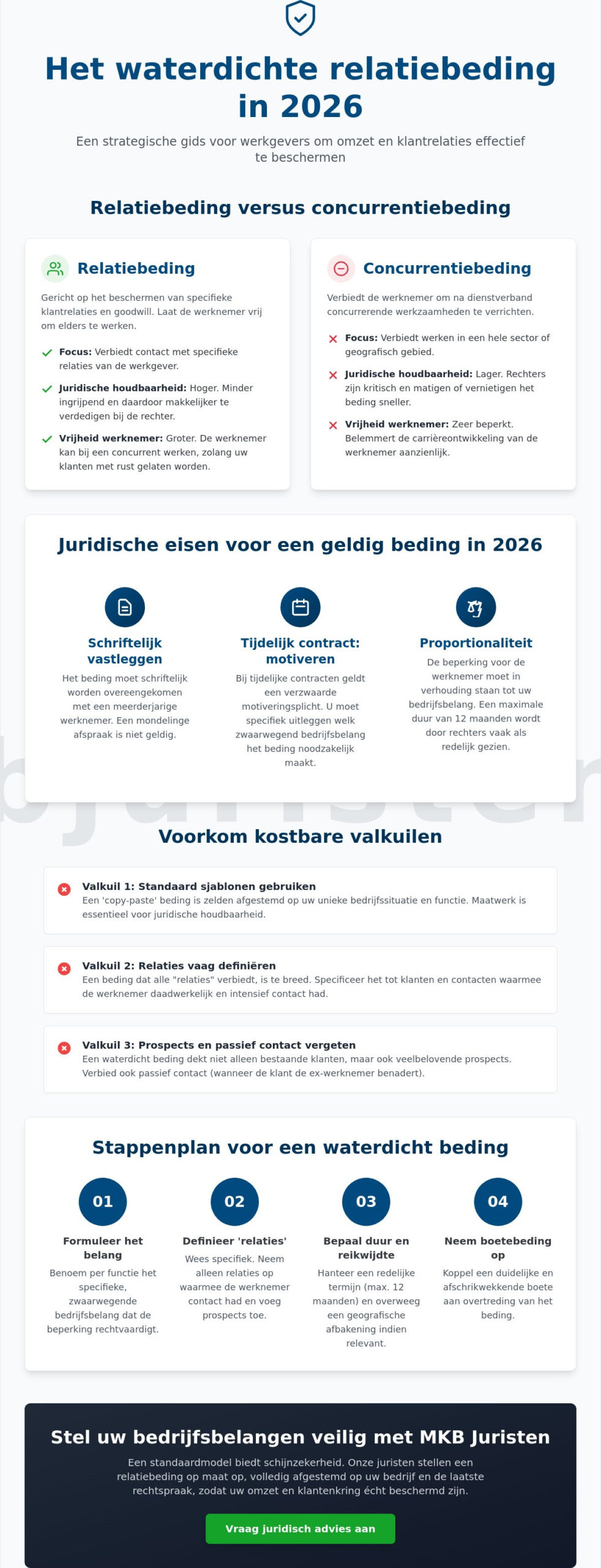
Step-by-step plan for a watertight non-compete clause
Drafting a non-compete clause as an employer is not a one-off administrative act, but a process that begins with a thorough analysis of your own company. Many employers skip this step and immediately resort to a standard text. This is risky. An effective clause is, after all, always custom-made. It must protect precisely those parts of your business that are vulnerable upon the departure of a key figure. By following a structured step-by-step plan, you build a case that not only works preventively but also holds up during a legal dispute.
Steps 1 to 3: preparation
The first step is an honest inventory of your “warm” relationships. These are the customers and prospects with whom your employee has built a personal bond or for whom they possess sensitive pricing information. It makes no sense to include passive contacts; focus on the relationships that actually pose a risk to your revenue. Next, write the justification. Be as specific as possible regarding your market position and the unique knowledge the employee possesses. Why does contact between these two parties lead to direct damage for your company?
In the third step, you determine the reasonable term. Although you might be tempted to bind an employee for years, this is often legally untenable. In the current labor market, a term of 12 months is generally considered reasonable. Do you still wish to opt for 24 months? Then you must have very compelling reasons that you can demonstrate in writing. An excessively long duration is one of the most common reasons why judges moderate a clause or even dismiss it entirely.
Steps 4 and 5: the conclusion
The fourth step revolves around enforceability: the penalty clause. Without a concrete penalty, your clause is of little value, because otherwise you would have to prove the exact damages afterwards. In practice, this is extremely difficult. Formulate a penalty that is high enough to deter, but remain realistic. A fine of a year's salary for a single phone call will be immediately reduced by a judge. Link the penalty to a fixed amount per violation and an additional amount for each day the violation continues.
Finally, the formal completion is crucial. Ensure a wet signature on every page of the contract and hand a copy to the employee. Carefully store the original in the personnel file. Do you want maximum assurance that you do not overlook a single legal detail during the process? A ContractCheck™ guarantees that your documents are fully up to date with 2026 legislation. This allows you to do business with peace of mind, knowing that your client base is optimally protected.
Protecting your business interests with MKB Juristen
You now have a clear picture of the steps required to draft an employer non-compete clause. The theory is clear, but practice is often challenging. In the heat of the moment, many entrepreneurs resort to standard templates from the internet. This is one of the greatest dangers for your business. Generic text rarely takes into account the specific dynamics of your sector or the unique role of your employees. It is only during a legal dispute that you discover the clause is not watertight, and by then the damage to your revenue has often already been done.
MKB Juristen believes in the power of custom solutions. We translate complex legislation into understandable contracts that actually stand up in court. Whether you are hiring a new employee or wish to update your current personnel files, we ensure that your goodwill remains protected. Should a former employee approach your business contacts despite all agreements? We offer immediate assistance with enforcement. We take decisive action to stop further violations and secure your legal position, allowing you to continue focusing on growing your business. In situations where employee misconduct requires immediate intervention, it is essential to also know when and how to advice regarding summary dismissal to avoid legal errors.
Our approach: the ContractCheck™
The legal world never stands still. Although the new legislative proposal for the modernization of clauses will not yet officially come into force in June 2026, judges are already applying stricter standards regarding the duty to provide reasons and the duration of agreements. With our ContractCheck™ , we conduct a thorough analysis of your current employment contracts. We examine not only whether the wording is legally sound but also whether it still aligns with the actual work performed in the workplace. You will receive practical advice on how to implement the new agreements without putting unnecessary pressure on the employment relationship.
Why choose MKB Juristen?
We speak the language of the entrepreneur. Our specialization lies entirely with the corporate market and SMEs, meaning we know exactly what risks you face. No convoluted legal jargon, but down-to-earth advice and transparent rates. We stand by your side as a partner and guide in the complex landscape of employment law. Do you need broader support or advice regarding a specific conflict? Our experts offer expert legal assistance in employment law for every situation. Drafting a non-compete clause as an employer thus becomes a strategic move rather than an administrative burden. Contact us today to give your client base the protection they deserve.
Protect your customer base today
Protecting your goodwill and revenue begins with a legal foundation that stands up to scrutiny. As we have seen, drafting a non-compete clause for employers in 2026 is not a matter of standard clauses, but of sharp choices and specific justification for each position. By clearly defining the distinction between active and passive contact and avoiding pitfalls such as an overly broad definition of relationships, you prevent unnecessary risks when staff leave.
Since 2009, MKB Juristen has specialized in supporting entrepreneurs with practical advice without unnecessary legal red tape. We have helped hundreds of entrepreneurs protect themselves against unfair competition and capital destruction. Do you want to be sure that your current contracts still offer optimal protection?
Have your non-compete clause reviewed with ContractCheck™
With the right documentation in hand, you can continue building the growth of your business with peace of mind.
Frequently asked questions about the non-compete clause
Is a non-compete clause in a temporary contract always valid?
No, a non-compete clause in a temporary employment contract is only valid if you provide written justification for which compelling business interests make this necessary. Without this specific justification, the clause is legally void. When drafting a non-compete clause for temporary contracts, the employer therefore requires extra careful substantiation for each position to prevent the protection from being lost in court.
What is the difference between a non-solicitation clause and a non-compete clause?
A non-compete clause prohibits an employee from working for a direct competitor or starting a similar business of their own. A non-solicitation clause is more specific and only prohibits contact with or performing work for your existing customers and business relations. Therefore, the employee is allowed to work for a competitor, as long as they leave your carefully built client base alone.
How high can the penalty be in a non-compete clause?
The fine must be high enough to have a deterrent effect, but must not be disproportionate to the salary. Often, an immediately payable amount of several thousand euros per violation is chosen, supplemented by a fine for each day the violation continues. A judge can always reduce an excessive fine if it is not proportionate to the actual damage.
Can I still add a non-compete clause if the employee is already employed?
Yes, that is possible, but only if the employee explicitly agrees to this and signs a new agreement. In practice, this usually happens at a logical moment, such as a contract extension, a promotion, or a significant salary increase. Always ensure that the new agreement is recorded in writing to prevent evidentiary issues and disputes in the event of a departure.
Does the non-compete clause become void upon dismissal during the probationary period?
No, in principle the clause remains in force if the employment contract ends during the probationary period. However, judges examine the balancing of interests more strictly in such situations. If an employee has been employed for only two weeks, the likelihood that he could seriously harm your business interests is often small, meaning a judge will be more likely to moderate or invalidate the clause.
Do I need to add a list of clients to the non-compete clause?
It is not mandatory to attach a physical list, but it does offer the most legal clarity for both parties. A good alternative is a clear description, such as “all relationships with which the employee has had active contact during the last 12 months of employment”. The more concretely the definition is formulated, the smaller the chance of differences in interpretation during a legal dispute.
What can I do if a former employee contacts my customers?
First, gather hard evidence of the violation, such as emails, text messages, or witness statements from your customers. Next, immediately send a registered letter of demand in which you remind the former employee of the clause and claim the penalties due. Drafting a non-compete clause as an employer is the necessary foundation, but active enforcement and documentation are essential to actually safeguard your revenue.
Is a non-compete clause also valid for self-employed professionals?
Yes, you can also agree on a non-compete clause with a self-employed professional, but this falls under general contract law and not employment law. Therefore, the specific protection rules for employees under the Civil Code do not apply directly here. It is essential to include this clause clearly and professionally in the contract for services to protect your commercial interests and goodwill when hiring externally.




