

MKB Juristen drafts custom legal documents
It is best not to cobble together or copy important contracts, terms and conditions, and other legal documents yourself. We help entrepreneurs on a budget with customized legal solutions, clear costs upfront, and practical explanations.
- Custom contracts, terms and conditions, and legal documents
- Budget-friendly and clear about the costs upfront
- Request a free consultation or a no-obligation quote
For you as an employer, summary dismissal is not an emotional decision, but a precise legal operation where timing is often more important than the burden of proof itself. When trust in an employee is suddenly lost due to serious misconduct, you want to be able to act immediately. Nevertheless, the fear of costly proceedings before the subdistrict court and uncertainty regarding the term "without delay" are often significant. Precisely for this reason, concrete advice on summary dismissal is crucial to prevent a justified decision from turning into a legal debacle. It is not without reason that the Juridisch Loket saw a 19 percent increase in inquiries regarding this complex subject in 2025.
We understand that the emotional stress of personnel matters is already heavy enough without the threat of fair compensation or a transition payment that could amount to up to €102,000 in 2026. In this guide, you will discover how to issue a legally valid dismissal that will stand up in court, so that you minimize the financial risks for your organization. We take you step-by-step through the legal procedure, explain the strict requirements of the law, and ensure that you make the right decisions with complete certainty.
Key Points
- Understand why summary dismissal is the most severe measure and why immediate termination without a notice period is subject to strict rules.
- Learn the three crucial conditions, including the necessity of urgent cause and taking immediate action upon detection of the misconduct.
- Avoid enormous financial risks, such as retroactive wage payments and equitable compensation, by following a flawless procedure.
- Receive practical advice on summary dismissal regarding initiating a suspension and correctly recording your employee's statement.
- Discover how an expert assessment of your case helps draft a legally watertight resignation letter.
What is summary dismissal and when is it an option?
Summary dismissal is the most drastic measure you can employ as an employer. It means terminating the employment contract with immediate effect. There is no notice period, and wage payments cease immediately. In Dutch law, this is referred to as the 'ultimum remedium'; the very last resort. Because the consequences for the employee are far-reaching, the law imposes very strict requirements. An error in the procedure can lead to the employee's costly return or high compensation payments. Therefore, professional advice on summary dismissal essential before you take this step.
With this form of dismissal, you immediately deny the employee access to the workplace. All secondary employment benefits, such as a company car or a laptop, must usually be returned immediately. It is a business measure that you should never take purely out of emotion or anger. However justified your frustration may be, the judge looks only at the facts and the procedure followed. A hasty decision in the heat of the moment is often the basis for a lost lawsuit.
The difference between summary dismissal and regular dismissal
In the case of a regular dismissal, you request permission from the UWV in advance or ask the subdistrict court to dissolve the agreement. With summary dismissal, you bypass this preventive review. You make the decision yourself and execute it immediately. This offers speed but also entails risks. The employee has two months to challenge the dismissal in court. If the court rules that the dismissal was unjustified, the termination is annulled. The employee is then back in your service retroactively. You are then obliged to pay all outstanding wages, often increased by statutory surcharges and interest.
When do you, as an entrepreneur, choose this path?
You choose this path when the employment relationship has been irreparably damaged by an urgent cause. Consider situations such as theft, fraud, serious insult, or refusal to work without good reason. The impact on the rest of your team weighs heavily in this decision. If you accept serious misconduct, it damages the company culture and your authority as an employer. Nevertheless, careful consideration is necessary. Sometimes, drafting a settlement agreement with our legal support a safer route to part ways without the uncertainty of a lawsuit. Sound advice on summary dismissal helps you determine whether your case is strong enough for the most severe measure or if another path offers fewer risks.
The three strict conditions for a legally valid dismissal
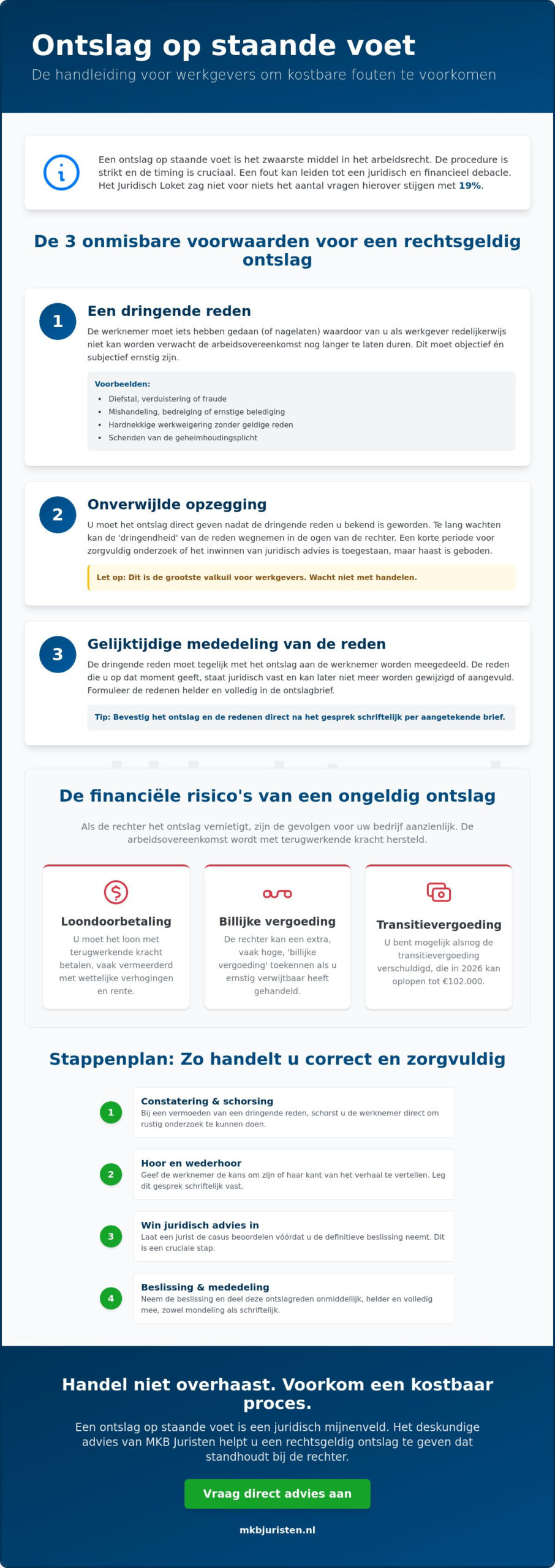
For a dismissal to stand up legally, you must meet three cumulative conditions. Cumulative means that you must score on all three points; if one is missing, the dismissal is unlawful. The subdistrict court judge is unforgiving in this regard. This makes sound advice on summary dismissal indispensable for every entrepreneur facing this drastic choice. The three anchor points are an urgent reason, immediate notice of termination, and simultaneous notification of the reason.
The final requirement, simultaneous notification, is sometimes underestimated in practice. At the moment of dismissal, the employee must know exactly why he is being sent home. The reason you provide at that moment is legally binding. You cannot supplement or modify it later in legal proceedings. Wording is everything here. A vague description such as 'unacceptable behavior' is often insufficiently specific to survive court proceedings.
What is considered an urgent reason?
An urgent reason is an act or characteristic of the employee that makes it unreasonable to expect you as the employer to continue the employment contract. Examples include theft, fraud, assault on colleagues, or persistent refusal of reasonable instructions. Both objective urgency (is the act serious enough in itself?) and subjective urgency (is it specifically unacceptable for your organization?) play a role here. A past incident rarely constitutes an urgent reason. If you have known about a case of fraud for months but have never intervened, the reason loses its urgent character under the law.
The pitfall of immediacy
Immediacy is the biggest stumbling block for management teams. It means that you must act immediately as soon as you become aware of the misconduct. However, this does not mean that you must dismiss immediately without an investigation. You are given time for a hearing and to gather evidence, provided you act expeditiously. A crucial step is immediately suspending the employee during this brief investigation. By doing so, you signal that the situation is untenable. However, if you wait several days without clear action or suspension, a judge will often rule that the necessity was apparently not that high. In complex cases, it is wise to legal assistance to maintain the proper pace of the process without making legal mistakes.
The risks and financial consequences of an incorrect procedure
Summary dismissal is a legal minefield. If you do not execute the procedure correctly down to the smallest detail, the financial balance will immediately tip against you. The risk is not limited to having to reinstate the employment relationship. The subdistrict court judge can order you to pay tens of thousands of euros. Expert advice on summary dismissal is therefore not a luxury, but a necessary insurance against unforeseen costs. In addition to direct wage costs, you also suffer reputational damage. A lost lawsuit regarding a wrongful dismissal damages your image as a good employer and can severely affect morale within your remaining team.
The wage claim and statutory increase
What exactly happens if the subdistrict court judge annuls the dismissal? The employee is then deemed never to have been out of service. This means that you must pay all outstanding wages from the day of dismissal up to the judge's ruling in a single lump sum. Because you paid the wages late, the judge may impose a statutory surcharge on top of this. This penalty can amount to as much as 50 percent of the gross wage. Add statutory interest and legal costs to that, and the bill quickly becomes unmanageable. In many cases, a suspension with pay during the investigation is a safer route. While you keep the employee off the work floor, you prevent the explosive growth of wage claims if the case file later turns out to be thinner than expected.
The transition payment and equitable compensation
Since January 1, 2026, the maximum transition payment has been set at €102,000 gross. In the case of a legally valid summary dismissal, the right to this payment usually lapses, as this constitutes seriously reprehensible conduct by the employee. However, if the court rules that you, as the employer, acted too carelessly, the roles are reversed. You must then not only pay the regular compensation, but you also risk an equitable compensation. This is an additional compensation that the judge determines at their discretion when the employer has acted in a seriously reprehensible manner. For an accurate estimate of these items, you can calculate the employer's transition payment yourself via our knowledge base. Avoiding this double financial penalty is the most important reason never to proceed with termination without professional advice on summary dismissal
Step-by-step plan for employers: how to act correctly
Summary dismissal stands or falls on razor-sharp execution. Even in the case of a clear misstep by an employee, you can lose the case if you neglect the procedural steps. It is a process in which speed and thoroughness constantly challenge each other. To ensure immediacy and simultaneously build a robust case file, a methodical approach is required. Therefore, follow this step-by-step plan to protect your legal position.
- Step 1: Immediate suspension and factual investigation. As soon as suspicion of urgent cause arises, immediately place the employee on non-active duty. This creates the necessary distance to gather evidence without the situation in the workplace escalating further.
- Step 2: Apply the principle of hearing both sides. You must give the employee the opportunity to respond to the accusations. Immediately record the statement given by the employee in writing.
- Step 3: Seek legal advice. Before communicating the final decision, an assessment of its legal validity is essential. Professional advice on summary dismissal helps you determine whether the reasons carry enough weight for the subdistrict court judge.
- Step 4: Draft the dismissal letter. The letter must describe the urgent reason crystal clear. Preferably hand it over personally in the presence of a witness and have the employee sign for receipt.
- Step 5: Complete the file. Ensure that all evidence, such as camera footage, log files, or witness statements, is stored securely and in an organized manner for a potential lawsuit.
Hearing both sides: a crucial step
Why is hearing the employee such a crucial part of the proceedings? A judge always assesses whether you have acted with due care and whether there is no misunderstanding. By giving the employee the opportunity to tell their side of the story, you avoid surprises later during a hearing. Always bring a witness to this meeting, such as an HR advisor or a co-owner. The report of this meeting forms an essential piece of the puzzle in your evidence; it irrefutably captures the employee's initial reaction.
Legally sealing off the resignation letter
The dismissal letter is the foundation upon which your entire case rests. The facts you state in it determine the scope of the legal dispute. Do you cite too many reasons that you cannot substantiate later? Then that weakens your credibility. Do you provide too few details? Then you may not add them later in the process. It revolves around the essence of the urgent cause. Would you like to know more about how to build a case file that stands up to scrutiny? Then take a look at our comprehensive guide on building a case file for employer dismissals. Do you currently have an employee you wish to dismiss immediately? Have our experts assess your case directly via legal advice for businesses to rule out unnecessary risks.
How MKB Juristen supports you with dismissal procedures
Summary dismissal is a drastic decision that you, as an entrepreneur, would rather not make. However, when the situation calls for it, it is reassuring to have a partner who removes the emotion from the matter and focuses on the legal facts. We support you by assessing your case immediately and critically. Our legal experts look not only at what has happened, but above all at how to phrase it in a legally sound manner. We assist you in drafting a watertight dismissal letter and offer practical guidance during the dismissal interview. Our approach is always aimed at preventing costly escalations to the sub-district court by providing pragmatic and level-headed advice.
We often see that entrepreneurs are uncertain about the burden of proof or the exact wording of the urgent cause for dismissal. In such cases, we act as your external legal department. We weigh the risks against each other and advise you on the safest route. Sometimes summary dismissal is the only way, but in other situations, a settlement or an improvement plan may be wiser to limit the financial risks for your company. Are you unsure whether an amicable settlement is feasible? Our practical checklist for drafting a settlement agreement helps you navigate that route in a legally watertight manner as well. For a broader perspective on how to handle your personnel matters in a legally watertight way, our guide on legal advice regarding employment law for employers valuable insights for every entrepreneur.
Speed and certainty for the entrepreneur
In employment law, speed is essential, especially given the requirement of immediacy. We understand that you cannot wait for a slow process. That is why we act immediately when you need us. Our working method is transparent, and we maintain clear rates without the unnecessary bureaucracy of a traditional law firm. With us, you get a dedicated contact person who speaks the language of the entrepreneur and delivers immediate results. Would you like to know how we can specifically assist you with an ongoing case? Then please visit our legal assistance page for an overview of our services.
Prevention for the future
In addition to assisting with urgent dismissal cases, we are happy to look ahead with you. Many legal problems arise from outdated or incomplete documentation. We can review your employment contracts and advise you on implementing clear internal codes of conduct and a transparent sanctions policy. This ensures your employees know exactly where the boundaries lie, and you are in a much stronger legal position should things unexpectedly go wrong. Do you currently have an urgent situation in the workplace? Then contact us immediately for expert advice on summary dismissal and prevent an incorrect procedure from costing you unnecessary money.
Take control of your personnel matters
Summary dismissal is one of the most challenging situations for an entrepreneur. You have read in this guide that timing and a watertight case file make the difference between a justified decision and a costly mistake at the subdistrict court. With increased transition payments and strict requirements regarding immediacy in 2026, you simply cannot afford any missteps. That is precisely why professional advice on summary dismissal essential to restore calm and certainty within your organization.
Since 2009, we have been supporting SME entrepreneurs with down-to-earth and pragmatic advice free from unnecessary legal jargon. We understand how doing business works in practice and, as SME Lawyers, stand by your side as an expert partner to minimize risks. Do not wait until a situation escalates; choose a methodical approach that stands up in court. Seek legal advice immediately regarding summary dismissal and ensure you can do business again with peace of mind.
Frequently asked questions about summary dismissal
When is a summary dismissal immediate?
A dismissal is considered immediate if you issue it immediately after the urgent reason becomes known. You may conduct a brief investigation into the facts, but you must take immediate action, such as suspending the employee. If you wait too long without a valid reason, the dismissal loses its immediate nature and the decision will not stand up in court.
Do I have to pay a transition payment in the event of summary dismissal?
In most cases, you are not required to pay a transition payment because the employee's conduct is seriously culpable. However, please note: if a judge later rules that the dismissal was unjustified, you will still be required to pay the compensation. In 2026, this compensation can amount to a maximum of €102,000 gross, which underscores the importance of proper advice regarding summary dismissal .
Can an employee challenge the dismissal afterwards?
Yes, an employee has exactly two months from the date of dismissal to challenge the decision before the subdistrict court. After this period, the right to request the annulment of the dismissal expires. Because the consequences are significant, more and more employees are seeking legal assistance; the Juridisch Loket already saw a 19 percent increase in such inquiries in 2025.
What if the employee is sick during the incident?
Illness offers no protection against summary dismissal if there is an urgent reason. This is because the prohibition against dismissal during illness does not apply in this situation. However, you must be extra careful in building your case file to demonstrate that the misconduct is unrelated to the employee's medical condition. Dismissing a sick employee always requires very strong legal substantiation.
Is theft always grounds for immediate dismissal?
Although theft often constitutes grounds for immediate dismissal, the judge always takes all circumstances into account. A theft of minor value by an employee with a very long tenure may sometimes be deemed insufficient grounds for the most severe sanction. Consistency in your policy and a clear code of conduct within your organization are crucial for your success before the subdistrict court.
What is the minimum content of a resignation letter?
A letter of resignation must describe the urgent reasons factually and specifically. Clearly state that the employment contract is being terminated with immediate effect and explain why the reason is so serious that continuation is impossible. The reasons you mention in the letter form the legal basis; you cannot expand or modify them later in legal proceedings.
Can I still withdraw a summary dismissal?
You cannot unilaterally withdraw a dismissal once it has been given. As soon as the notification has reached the employee, the termination is final. Withdrawal is only possible if the employee agrees, for example during a settlement or negotiation. Therefore, be absolutely certain of your case and always seek advice regarding summary dismissal before giving the notification.
How long may an investigation into an urgent reason take?
There is no fixed time limit, but the investigation must proceed expeditiously. Usually, it involves a few days. For an entrepreneur, this means taking action immediately after the discovery by hearing witnesses or gathering evidence. As long as you immediately suspend the employee and actively work on the investigation, you remain within the bounds of immediacy.




