

MKB Juristen drafts custom legal documents
It is best not to cobble together or copy important contracts, terms and conditions, and other legal documents yourself. We help entrepreneurs on a budget with customized legal solutions, clear costs upfront, and practical explanations.
- Custom contracts, terms and conditions, and legal documents
- Budget-friendly and clear about the costs upfront
- Request a free consultation or a no-obligation quote
Did you know that a judge will immediately dismiss a dismissal application if you cannot demonstrate that you offered your employee a fair chance for improvement? After all, a successful case file is not about simply collecting errors, but about proving good employership. We understand that the fear of rejection or an extremely high equitable compensation weighs heavily, especially now that the maximum transition payment has been set at €102,000 gross in 2026. The uncertainty regarding the legal requirements of the 'i-ground' (grounds for dismissal) and the chronic lack of time for administration make the process difficult for many entrepreneurs. Nevertheless, careful dossier building regarding dismissal is the only way to avoid costly procedures and unnecessary financial risks.
In this article, you will discover how to build a legally sound case file that will stand up in the subdistrict court. We offer a clear step-by-step plan in which we explain exactly what requirements your documentation must meet and what role a formal improvement process plays in this. After reading, you will know exactly how to minimize legal risks and take the right steps within your organization with confidence.
Key Points
- Understand why the subdistrict court judge rigorously reviews your case against the Balanced Labour Market Act and how to prevent your dismissal application from being rejected.
- Discover the essential building blocks of a personnel file, ensuring that the file structure regarding employer dismissal is legally sound from day one.
- Learn why a single poor performance review is never sufficient for dismissal due to poor performance and exactly what requirements the grounds for dismissal must meet.
- Follow a concrete step-by-step plan to develop an effective improvement plan (PIP) to offer your employee a fair and documented chance at remediation.
- Strengthen your negotiating position and avoid costly proceedings by having your current files preventively reviewed for legal feasibility.
Why building a file during dismissal is crucial for every employer
The Balanced Labour Market Act (WAB) has set a high bar for dismissal. Since the evaluation of this law in 2025, we have seen that judges scrutinize the substantiation of dismissal requests even more critically. You cannot simply part ways with someone because things 'no longer click' or because results have been disappointing for a month. There must be a file that stands up to every scrutiny. Consistent documentation regarding employer dismissals is therefore your most important shield against unexpected legal claims and exorbitant compensation.
If your case file is flawed, you run the risk that the subdistrict court judge will simply reject the request for dissolution. This leads to an untenable situation: the employee remains employed, while the employment relationship is often already irreparably damaged. In the worst-case scenario, you will be ordered to pay equitable compensation. This is additional compensation on top of the transition payment, which in 2026 could amount to €102,000 gross or even a full annual salary if that turns out to be higher. However, a well-structured case file also works preventively; it clarifies expectations and prevents simmering dissatisfaction from escalating into a bitter labor dispute.
The legal burden of proof lies with the employer
In Dutch employment law, the burden of proof rests almost entirely with you. Oral agreements or informal warnings at the coffee machine have little value in court. The judge assesses whether there is a so-called fully substantiated ground for dismissal. Without written documentation of performance reviews, official warnings, and the assistance offered for improvement, you are left legally empty-handed. Moreover, a watertight file strengthens your position at the negotiating table. If an employee sees that you take the file regarding dismissal seriously, the willingness to part ways via a settlement agreement is often much greater. This saves you the trip to court and the associated court fees, which amount to €735 for legal entities in 2026.
Financial consequences of a deficient file
A weak case file often forces employers to rely on the i-ground, the so-called combination ground. While this can offer a solution for a file that is just incomplete on several points, it comes with a hefty price tag. In such cases, the judge may award additional compensation of up to half of the transition payment. By investing in professional legal advice on employment law for employers and maintaining tight records in a timely manner, you can avoid these extra wage costs and legal claims. It pays to start documenting immediately at the first signs of poor performance, so that you do not wait to take action until the conflict has already escalated.
The building blocks of a legally sound personnel file
A watertight case file does not start with the first official warning, but with the foundation of the employment relationship. After all, without a clear job description, a judge has no baseline against which to assess performance. How can you demonstrate that someone is falling short if expectations were never put in writing? Therefore, building a good case file for an employer-sponsored dismissal always starts with an up-to-date document describing tasks, responsibilities, and the required competencies. This forms the legal framework for every subsequent discussion.
Reports of performance and appraisal interviews form the backbone of your file. In practice, we often see that employers are too cautious in these reports. Terms such as “things are going reasonably well” or “there are some areas for improvement” are far too vague for a dismissal procedure. Be specific. Note exactly what is going wrong, what the consequences are for the organization, and what concrete agreements you are making to rectify the situation. If the situation does not improve despite these discussions, the next step is formal written warnings. These documents build upon the seriousness of the situation and demonstrate to the judge that the employee knew their job was at stake.
Gathering objective evidence
Judges base their judgment on facts, not on your personal gut feeling. Instead of writing that an employee is “often late,” note the exact dates and times. Also use external signals as evidence. Customer complaints or negative feedback from colleagues are strong pieces of evidence, provided you share them directly with the employee and give them the opportunity to respond. A crucial detail here is the signature. Always ask the employee to sign the report. If they refuse, make a note yourself stating that the report has been discussed and that the employee refuses to sign “for acknowledgment.” To draft legally sound documents, you can use our Employment Contracts , which provide the right framework for your personnel policy.
Digital traces and privacy
In the modern work environment, much communication takes place via email or WhatsApp. These messages can serve as evidence, but you must comply with the GDPR. Searching a business mailbox arbitrarily is not permitted without a valid reason and a pre-established protocol. A clear employee handbook is indispensable in this regard. In it, you establish the rules for the use of business communication tools and the conditions under which you may conduct checks. This prevents important evidence from being excluded by the court due to an infringement of the employee's privacy. Consistent documentation regarding employer dismissals therefore requires not only discipline in reporting but also a privacy-proof policy that stands up to scrutiny.
Building a case file in cases of dysfunction: the requirements of the sub-district court judge
How does a subdistrict court judge assess whether an employee is justifiably dismissed for poor performance? In practice, the so-called "d-ground" is one of the most difficult grounds to successfully substantiate. After all, a judge looks at the big picture. He asks himself whether the employee knew what was expected of him and whether he received sufficient assistance to improve his performance. A single negative evaluation is never sufficient. The case file regarding the employer's dismissal must demonstrate a pattern of structural shortcomings that persist despite repeated feedback.
In addition, you, as an employer, have a heavy obligation to provide training. Before proceeding with dismissal, you must demonstrate that the poor performance could not simply be remedied by a course or training. The obligation to reassign is also a critical step. You are required to seriously investigate whether the employee can be reassigned to another suitable position within a reasonable timeframe, possibly with the aid of training. Only when you can prove that there are no other possibilities within the organization does dismissal due to poor performance come into play.
The improvement process as a core component
What does the judge understand by a realistic chance of improvement? This means that you do not merely provide a list of errors, but also offer active guidance. Consider weekly progress meetings, coaching by a senior colleague, or an external program. The duration of such an improvement plan depends on the complexity of the position and the employee's experience. In most cases, a period of three to six months is considered reasonable. Document every step of this process in your employer dismissal file. Without proof of this active support, a judge will irrevocably reject the dismissal request.
The combination land (i-land) as a safety net
Sometimes you have a case file that is just not strong enough for dismissal on several points. The employee is performing poorly (ground d) and there is also a strained employment relationship (ground g). Since the introduction of the Balanced Labour Market Act, you can invoke the i-ground, the combination ground, in such cases. This offers a solution for a “nearly” case file, but bear in mind the financial consequences. The subdistrict court judge may decide that you must pay an additional compensation of up to 50% of the transition payment. Given that the maximum transition payment amounts to €102,000 gross in 2026, this additional cost can add up significantly. For strategic legal advice regarding this combination ground, it is wise to engage an expert early on.
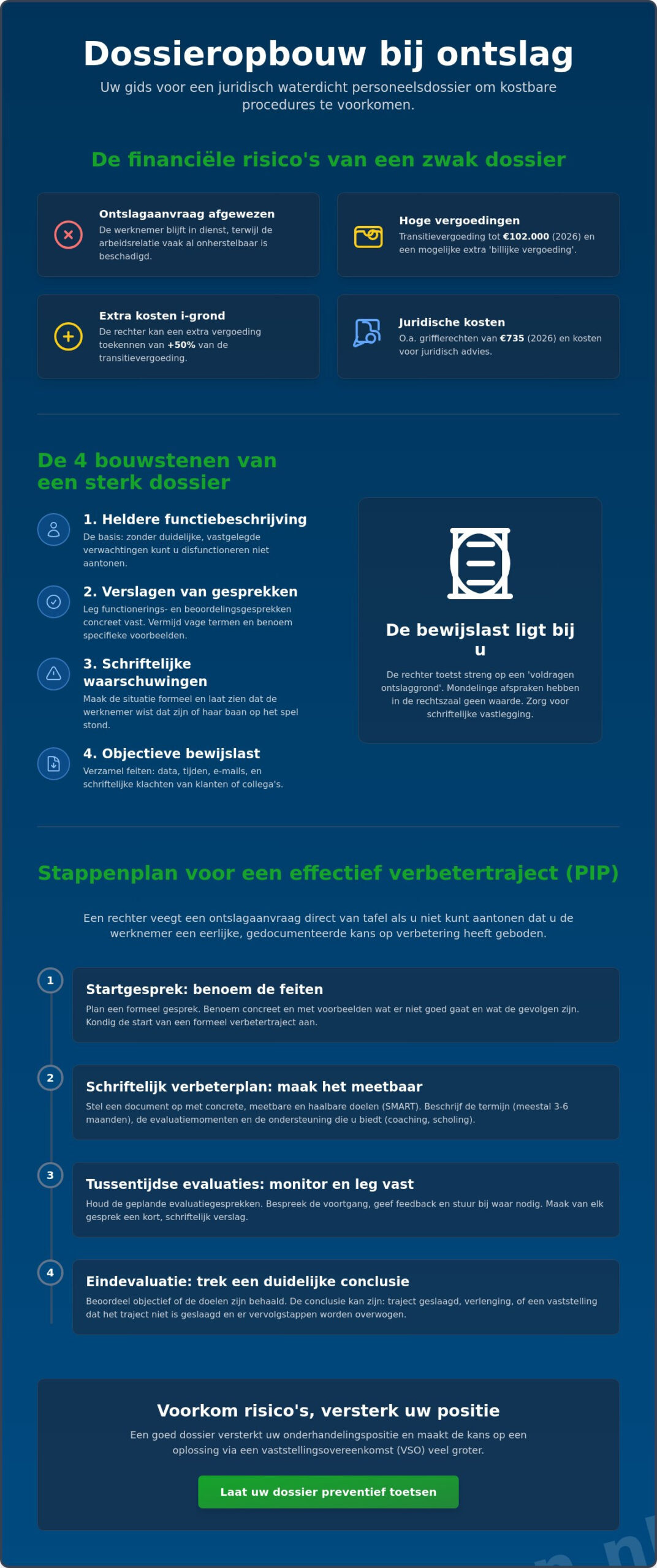
Step-by-step plan for an effective improvement process and file building
a successful employer-sponsored dismissal case file relies on a structured approach. You cannot rush into things; the subdistrict court judge expects a logical process in which the employee has been repeatedly informed of their shortcomings. The process begins at step 1: identifying the problems and raising them in writing. Do not wait until the official performance review round, but initiate a conversation immediately as soon as performance falls short. Always confirm this conversation by email so that the timeline for your case file starts immediately.
In step 2, you draw up a concrete improvement plan, also known as a Performance Improvement Plan (PIP). In this plan, you specify what needs to change and within what timeframe. Step 3 consists of the interim evaluations. Schedule these meetings, for example, every two weeks, and make a brief report of each meeting. The final evaluation follows in step 4. Here you draw the conclusion: has the employee improved sufficiently, or is dismissal the only remaining option? The final and most crucial step is the legal review. Before submitting the dismissal application, you must be certain that your file contains no gaps.
Setting concrete goals in the improvement plan
Vague slogans such as “you need to become more proactive” have no value in a courtroom. Therefore, make goals SMART: specific, measurable, acceptable, realistic, and time-bound. Instead of “better communication,” agree that the employee “shares a status update on all ongoing projects every Friday before 4:00 PM.” Also, explicitly record what support you will provide. Consider coaching, a weekly Q&A session, or a specific course. Note: if an employee falls ill during the process, you are pressing the pause button. Legally, an improvement plan cannot continue during illness; the term is simply extended by the duration of the absence.
Dealing with an unwilling employee
Sometimes an employee refuses to cooperate with an improvement plan or fundamentally disagrees with the criticism. This does not relieve you of your duty to build a file. On the contrary; the refusal itself becomes part of your file. Continue to invite the employee for meetings and document in writing that they do not appear or refuse to discuss the goals. In such cases, official warnings for work refusal are essential to substantiate the seriousness of the situation. Do you notice that the situation is escalating or that the employee is starting to dig in legally? Then do not wait and immediately engage legal assistance . Early intervention can prevent a difficult process from degenerating into a costly procedure. For a complete review of your documentation, you can always turn to us for tailored legal advice for businesses
Legal assistance with dismissal procedures and file management for SMEs
Building a case file is a time-consuming task that requires the utmost precision. Even a minor formal error or a missing report can lead to a dismissal application being rejected. MKB Juristen assists you in managing these risks and unburdening your organization. We assess the legal soundness of your current files and point out any blind spots a subdistrict court judge might identify. By utilizing an objective external perspective, you significantly strengthen your position. Thorough file building regarding employer dismissal often makes an employee more willing to discuss a severance package sooner. After all, when the evidence is convincing, the employee also realizes that legal proceedings have little chance of success.
With our ContractCheck™, we take a critical look at your existing personnel documentation. Are the performance improvement plan reports legally sound enough? Do the assessments align with the set goals? We offer not only advice after the fact but also help you set up a system that prevents future problems. Through clear processes and transparent communication, you create a calm work environment and minimize the risk of escalation.
Prevention through the right contracts
A watertight file starts at the foundation: the agreements you make at the start of employment. Drafting a good employment contract is essential for future reference. In it, you establish the framework for performance, secondary activities, and confidentiality. Additionally, an employee handbook is an indispensable tool. It contains the general rules of conduct and procedures that apply to everyone, which strengthens the objectivity of your file. Do you also want to protect your valuable client relationships when an employee leaves? Then it is wise to drafting a non-compete clause , ensuring your client base and revenue are legally protected. For entrepreneurs who want everything properly arranged from the start, we have developed the legal business starter package . With this, you lay a solid foundation for your personnel policy.
Assistance with the resignation application
If an improvement process does not lead to the desired result, we support you with the next steps. Whether it involves a procedure via the UWV or the sub-district court, we ensure that the documentation regarding your employer-dismissal case aligns seamlessly with legal requirements. However, going to court can often be avoided by drafting a legally correct settlement agreement. We negotiate the terms on your behalf, ensuring you can part ways in a proper and financially responsible manner. Do you currently have a case you are unsure about? Then contact us immediately for legal advice. We would be happy to review it with you to determine the most efficient route in your situation.
Take the step towards a legally secure personnel policy today
A watertight file is your best insurance against unexpected dismissal costs and protracted legal proceedings. You have seen that building a successful dismissal file rests on three crucial pillars: objective reporting from day one, a transparent improvement plan with SMART goals, and an active, supportive attitude as an employer. By consistently following these steps, you reduce the risk of rejection by the subdistrict court judge and significantly strengthen your position at the negotiating table.
Do you want to be sure that your documentation stands up to scrutiny? Since 2009, MKB Juristen has been the trusted partner for entrepreneurs seeking a pragmatic approach free from dusty jargon. We specialize in SME employment law and understand your company's day-to-day operations like no other. Have your dismissal file reviewed by our legal experts and prevent minor procedural errors from leading to major financial consequences, such as equitable compensation. Together, we ensure a result-oriented solution that allows you to look ahead with peace of mind.
Frequently asked questions about file building
How long does it take on average to build a file for dismissal?
On average, the process of building a case file takes between three and six months. The exact timeframe depends on the seniority of the position and the nature of the dysfunction. A longer improvement plan is often expected for an experienced manager than for an employee in an executive role. It is essential that the employee is given a fair opportunity to improve performance before you take further legal action.
Is a verbal warning sufficient for a dismissal file?
From a legal perspective, a verbal warning is almost never sufficient as evidence. Although you initiate conversations verbally, these must always be confirmed in writing by email or letter to have value in court. Without this written record, the subdistrict court judge cannot objectively determine that the employee was officially aware of the shortcomings and the potential consequences for the employment.
What should I do if an employee refuses to sign a report?
You cannot force an employee to sign, but you can formally document the refusal. Note at the bottom of the report that the conversation took place and that the employee refuses to sign for agreement or acknowledgment. Then send the report to the employee by email or registered mail. This proves that the content was shared and that the employee had the opportunity to respond in writing.
Can I dismiss an employee without a file in the event of a strained employment relationship?
Dismissal without a proper file has become virtually impossible under current legislation in the case of a strained employment relationship. The subdistrict court requires proof that the strain is serious and lasting and that you have attempted to repair the relationship, for example through mediation. In these situations, inadequate documentation regarding the employer's dismissal often leads to a rejection of the request or a very high equitable compensation for the employee.
How many official warnings do I have to give before dismissal?
The law does not specify a particular number of warnings, but in practice, a series of three written warnings is usually adhered to. This often begins with an official warning, followed by a second warning, and ends with a final warning in which dismissal is explicitly announced. The key is to demonstrate that the employee has repeatedly been given the opportunity to adjust their behavior or performance to the established standards.
Am I allowed to use private conversations via WhatsApp in the file?
Business WhatsApp messages may be used as evidence, provided they are relevant to performance or the employment dispute. However, be cautious with private conversations due to privacy legislation. It is always wiser to conduct official communication regarding performance via business email. If you use WhatsApp messages, save the screenshots directly to the personnel file to ensure context and the correct timeline.
What is the role of training in building a file regarding dysfunction?
Training is a legally mandatory part of the performance improvement plan that you may not skip. The employer must investigate whether the employee's shortcomings can be resolved through a targeted course or training. In your employer dismissal file, you must explicitly demonstrate which training opportunities you offered and why these may not have led to the desired result within the stipulated timeframe.
What happens to the file when an employee reports sick?
In the event of a sick leave notification, an ongoing performance improvement plan is, in principle, immediately paused. A prohibition on termination applies during illness, which means that you cannot proceed with the dismissal procedure as long as the employee is officially incapacitated for work. As soon as the employee has been declared fully recovered by the company doctor, you can pick up the thread of the file and the performance improvement plan exactly where you left off. Do you want to know in advance exactly what financial obligations you will face in the event of a potential dismissal? Then also read our comprehensive guide on calculating a transition payment as an employer, so that you are fully prepared for the costs of a dismissal process.




