

MKB Juristen drafts custom legal documents
It is best not to cobble together or copy important contracts, terms and conditions, and other legal documents yourself. We help entrepreneurs on a budget with customized legal solutions, clear costs upfront, and practical explanations.
- Custom contracts, terms and conditions, and legal documents
- Budget-friendly and clear about the costs upfront
- Request a free consultation or a no-obligation quote
Imagine this: a valuable shipment is damaged during transport and your customer refuses to pay the invoice, while you assumed the risk had already passed. Without tailored delivery terms, you are often left empty-handed in such a situation and bear the financial loss yourself. It is a painful scenario that we frequently see among entrepreneurs who rely on generic online templates or vague agreements. After all, you want to do business with the certainty that your legal position is strong, regardless of what goes wrong during the process.
We understand that legal documents are not at the top of your favorite to-do list, but the fear of unforeseen liability and issues with defaulting debtors is a real concern for every SME entrepreneur. In this article, you will discover how tailored terms and conditions of delivery minimize your business risks and strengthen your collection position. We discuss the current legal frameworks of 2026, such as the B2B interest rate of 10.15%, and show how professional terms ensure faster payments. This not only creates legal peace of mind for yourself but also immediately projects authority to your customers.
Key Points
- Understand why copying standard templates makes your business vulnerable to unforeseen damage claims and legal loopholes.
- Discover how tailored delivery terms determine the exact moment of risk transfer, ensuring you never remain unintentionally responsible for damage during transport.
- Learn how to optimally align your legal terms with your business insurance to prevent gaps in coverage.
- Gain insight into the crucial role of a modern force majeure clause in the event of logistical delays or other external factors.
- Read how a ContractCheck™ professionalizes your current documentation and immediately strengthens your position regarding outstanding invoices.
Why standard terms of delivery pose a risk to your business
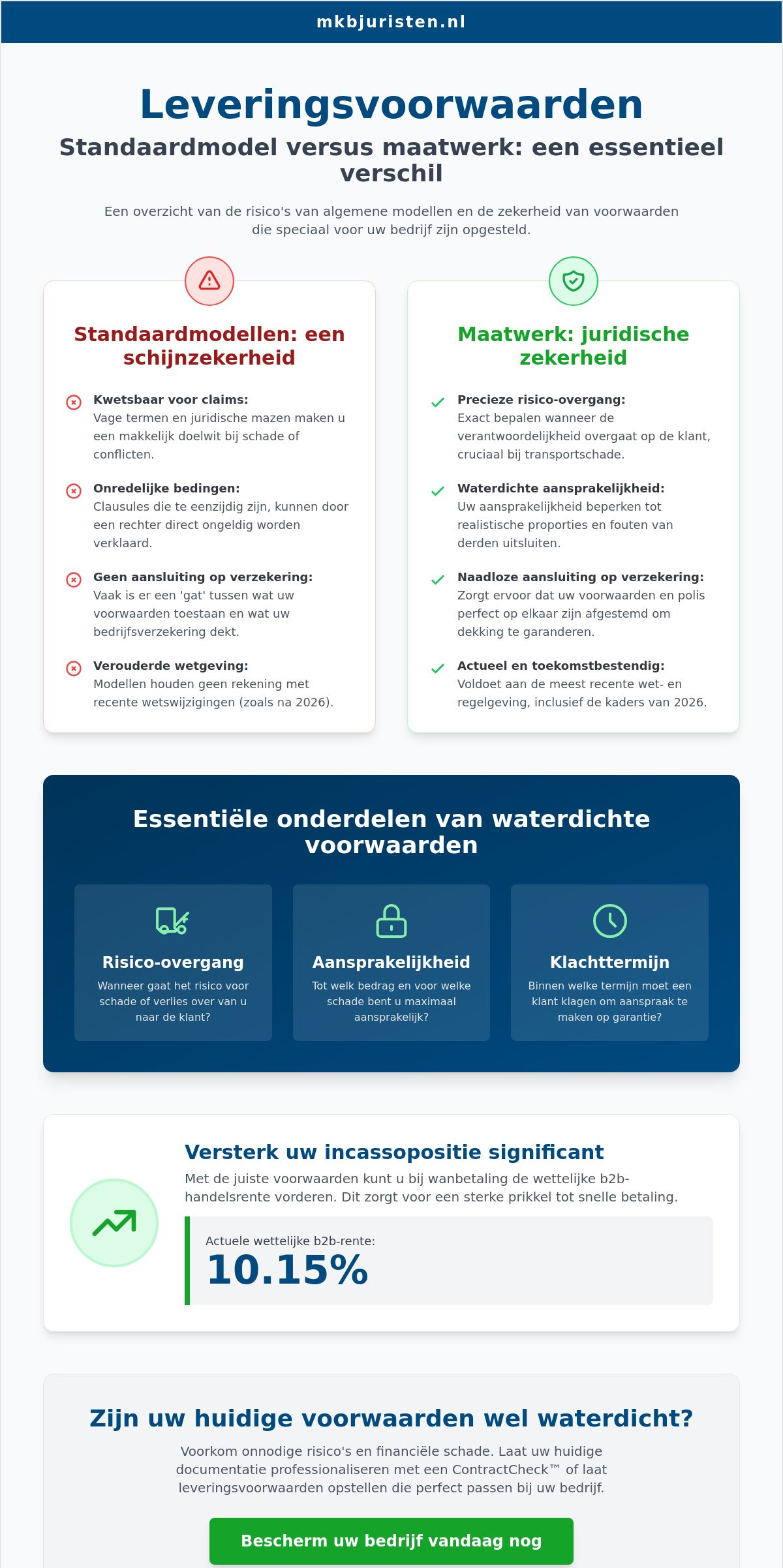
Terms of delivery form the backbone of your operational process. They fall under the broader legal basis of general terms and conditions and specifically regulate everything surrounding the physical or digital transfer of your product. Many entrepreneurs make the mistake of simply copying a competitor's terms and conditions or downloading a generic online template. This seems like a quick and cheap solution, but it creates a false sense of security. A document that is not tailored to your specific way of working often contains loopholes that a legally trained counterparty can easily exploit.
The greatest danger of such copy-paste documents is the presence of unreasonably burdensome clauses. Under Dutch law, clauses that unduly disrupt the balance between entrepreneur and customer can be immediately annulled by a judge. This often happens with templates that exclude overly general liability or employ impossible payment terms. Additionally, you face the battle of forms. This legal battle determines whose terms apply when both you and your business customer apply your own rules. Without tailored terms of delivery, you often come out on the losing end in such conflicts, simply because your standard text is not specific enough to effectively exclude the other party's terms.
The hidden dangers of generic models
Standard templates are, by definition, written for the masses. They do not take into account the nuances of your logistics process or the unique risks of your product. Do you sell perishable goods, software licenses, or heavy machinery? The risks differ enormously. Vague terms in a template often lead to lengthy and expensive proceedings regarding the interpretation of a sentence in the event of damage. Moreover, general terms and conditions rarely align seamlessly with your business insurance. If your terms and conditions accept a risk that your insurer explicitly excludes, you bear the financial consequences entirely yourself.
When standard terms and conditions simply no longer suffice
As your business grows, the stakes rise. What worked as a freelancer is insufficient for a growing SME with larger contracts. Moreover, the legal world does not stand still. Since January 1, 2026, the system of bilateral general terms and conditions via the SER has been terminated, meaning that you can no longer rely on those familiar frameworks for new contracts. New European directives regarding warranty and repair also necessitate sharper wording. Tailored terms of delivery ensure that you comply with the most current legislation and industry requirements, thereby preventing disputes with customers and regulators.
What exactly customized delivery terms entail
Customization is not a luxury; it is a necessity for sound business operations. While standard documents often remain vague, tailored terms and conditions delve deep into your daily workflow. We look not only at the law, but primarily at how you do business. Do you ship physical products via courier or provide digital services in the cloud? Every sector requires specific clauses. For a construction company, provisions regarding working days are crucial, while since June 2026, a webshop is required to offer a clear right of withdrawal button to comply with the latest regulations. Entrepreneurs selling online would therefore be wise to have their webshop terms and conditions drafted by a specialist who is up to date with these current obligations.
The KVK Ondernemersplein regularly emphasizes the importance of general terms and conditions to prevent legal conflicts. With custom solutions, we translate this importance into concrete actions. We establish who is responsible if a shipment is delayed or if a customer claims that a package never arrived. By taking your operational process as the starting point, we close loopholes in the law that are wide open in standard templates. This gives you the peace of mind to focus on growth instead of potential conflicts.
The transfer of risk and liability
An essential part of customization is determining the transfer of risk. Is the customer responsible as soon as the product leaves your warehouse, or only when it crosses the threshold of their office? This distinction is crucial for damage claims during transport. With good terms and conditions, you limit your liability to realistic proportions, ensuring you are not held responsible for errors made by external carriers. We also establish a strict complaint period. If a customer only complains about a minor scratch after three months, you must be within your rights to reject that claim. Would you like to know if your current agreements are still watertight? Our legal experts can draft your contracts to effectively cover these risks.
Financial security through smart terms
Your cash flow is the fuel of your business. That is why we build in a strong retention of title clause. This means that the goods legally remain yours until the last cent has been paid. Should a customer go bankrupt, you can simply reclaim your goods from the bankruptcy estate. In addition, we integrate clauses for interest and collection costs that comply with the Debt Collection Costs Act. For business transactions, we apply the statutory commercial interest rate of 10.15%, which has been in effect since July 2025. The right of retention is also a powerful tool: you may suspend the delivery of a new product as long as old invoices remain outstanding. These kinds of practical instruments make the difference between a paper tiger and an effective collection tool.
The advantages of custom-made models compared to free models
If you opt for a free template from the internet, you are often unintentionally choosing a ticking time bomb for your business operations. Although the savings may seem attractive in the short term, standard terms and conditions often lead to exorbitant legal costs at the very first conflict. Drafting watertight terms of delivery is more than just filling in a template; it is a strategic investment in your security. Professional clients immediately recognize the quality of your documentation. The use of custom-made terms of delivery projects authority and increases your acceptance rate among major players accustomed to strict legal frameworks.
Another often underestimated benefit is alignment with your business insurance. Insurers set specific requirements regarding the limitation of your liability. If your general terms and conditions do not seamlessly align with your policy conditions, you run the risk that your insurer will not pay out in the event of damage. Customization ensures that these two crucial documents reinforce each other rather than work against each other. For entrepreneurs looking for a complete overview of what legal customization entails and why it will be indispensable in 2026, our comprehensive guide on tailored general terms and conditions all the answers. Curious about the investment involved? In our guide on the costs of drafting general terms and conditions, we offer full transparency regarding rates in 2026.
Legal validity in court
In a legal dispute, a judge scrutinizes the reasonableness of your terms and conditions. Standard templates often contain so-called "stranglehold contracts" that are immediately voidable in practice. With custom terms, we formulate clauses that are legally sound because they are proportionate to your services. The duty to inform also plays a major role in this. We advise you not only on the content but also on how to correctly provide your terms and conditions. Without this proper procedure, even the best terms are worthless in court. With custom general terms and conditions, you prevent your most important protection from being swept off the table with a single stroke of the pen.
Operational efficiency for the entrepreneur
Good terms and conditions act as a manual for your own organization. Your staff knows exactly which framework to follow during discussions regarding warranties, returns, or delayed deliveries. This saves you time and frustration every day. Instead of negotiating on a case-by-case basis, you simply refer to the clear agreements you established in advance. This ensures a consistent and professional image towards your customers. Ultimately, it is about unburdening you: you want to focus on your profession, not on putting out legal fires that could have been prevented with a solid foundation.
Essential components of watertight terms of delivery
A legal document is only truly effective if it leaves no room for interpretation. Therefore, when drafting custom terms and conditions of delivery, we look beyond just standard clauses. It starts with a crystal-clear description of exactly what you are delivering. Lack of clarity regarding specifications or the scope of a service is the most common source of conflict. By documenting this in detail, you prevent a customer from claiming afterwards that the product does not meet expectations.
In a rapidly changing world, a modern force majeure clause is indispensable. Consider situations such as sudden raw material shortages, logistical blockades, or large-scale digital outages that are beyond your control. Intellectual property also deserves a prominent place. Especially with custom products or consultancy services, it must be clear who owns the designs, source code, or concepts after delivery. Finally, we handle dispute resolution: which law applies and which court has jurisdiction in the event of a conflict? For Dutch entrepreneurs, it is usually advisable to explicitly choose Dutch law and a court in their own region.
Retention of title and securities
Retention of title is your most important trump card with non-paying customers. It allows you to remain the legal owner of the delivered goods until the full invoice, including any interest, has been paid. Should a customer unexpectedly go bankrupt, you can immediately reclaim your assets from the bankruptcy trustee. For companies that supply parties who resell the goods, we often incorporate a comprehensive retention of title clause. This ensures that your rights remain safeguarded, even in complex supply chains. It is a relatively simple provision that can make the difference between a substantial write-off and securing your inventory.
Payment and default
Do you want to avoid having to endlessly beg for your money? Then strict deadlines are essential. By stipulating in your terms and conditions that the payment term is a strict deadline, default occurs immediately upon the date passing. A notice of default is then often no longer even necessary. In addition, we exclude the customer's right to set off or suspend payment. This means that a customer may not withhold an invoice because they believe they have another claim against you. Should payment remain outstanding despite these strict terms, you can immediately switch to professional debt collection assistance for businesses to collect your outstanding debt.
Are you wondering if your current terms and conditions contain these crucial elements? Have your documentation checked by an expert today and choose certainty with tailored delivery terms.
How MKB Juristen helps you with tailored terms and conditions of delivery
At MKB Juristen, we do not believe in thick reports that end up in a drawer. We opt for a pragmatic approach that delivers immediate results in your daily practice. We speak the language of the entrepreneur, not just the language of the law. This means that we translate legal risks into understandable choices. We understand the specific challenges of SMEs, where speed and clarity are often more important than endless legal hair-splitting. Thanks to our experience drafting contracts for various sectors, we know exactly where the shoe pinches regarding your operational protection.
Our support does not stop at providing a document. We help you customized terms and conditions of delivery a true part of your business operations. For example, how do you ensure they are correctly accepted by your customers? How do you train your sales team to make the right agreements? We stand by your side as an expert partner to ensure this transition runs smoothly. This allows you to build a solid foundation that enables you to accept new assignments with confidence.
The ContractCheck™: certainty for your documents
Do you already have terms and conditions, but doubt whether they still meet the current requirements of 2026? With our ContractCheck™, we screen your current documentation for critical vulnerabilities. We specifically examine compliance with the latest legislation and identify where your delivery process is at risk. An outdated document is often just as risky as having no document at all. Would you like to have your current contract reviewed by a legal expert? We ensure that your terms and conditions are fully up to date again, so that you will not face any surprises in the event of a dispute.
Personal advice without hidden costs
Transparency is at the core of our approach. With us, you know exactly where you stand in advance thanks to our fixed prices for custom solutions. No unexpected invoices afterwards, but a clear investment in the security of your business. We take the time to understand your workflow, ensuring the terms truly work for you rather than against you. Our legal experts combine their expertise with a pragmatic approach to doing business. This ensures you receive documents that are not only legally sound but also remain commercially viable.
Don't wait until a conflict forces you to put your affairs in order. Contact us today for tailored terms and conditions and immediately strengthen your company's legal foundation.
Build a secure future for your business
It is clear that a standard model can never fully cover the specific risks of your unique business process. By investing in tailor-made terms and conditions, you choose a legal shield forged precisely around your company. This not only prevents costly liability proceedings but also immediately strengthens your position with defaulters through clear collection provisions. This gives you the professional image needed to secure serious contracts and execute them with confidence.
MKB Juristen has specialized in contract law for SME entrepreneurs for over 15 years. With our unique ContractCheck™ method, we ensure that your documentation is not only legally sound but also truly aligns with your daily workflow and the most current legislation of 2026. Have your terms and conditions of delivery drafted to measure by MKB Juristen and experience the peace of mind of a watertight foundation for your business. We are ready to solve your legal challenges pragmatically and effectively.
Frequently asked questions about delivery terms
Are general terms and conditions and terms of delivery the same?
No, terms of delivery are a specific part of your general terms and conditions. Whereas general terms and conditions regulate the broad legal framework of the agreement, terms of delivery focus purely on the logistical and physical transfer of goods or services. This includes transport risks, delivery times, and the exact moment of risk transfer. It is essential that this component aligns seamlessly with your operational reality to prevent gaps in your liability.
Am I required to file my terms and conditions of delivery with the Chamber of Commerce?
Filing with the Chamber of Commerce (KVK) is not legally mandatory, but it can be advisable for evidentiary purposes. It provides official proof of the content of your terms and conditions on a specific date. However, filing never replaces the obligation to provide them. You must still actively provide your terms and conditions to your customer before or at the time the agreement is concluded to make them legally enforceable.
Can I copy the terms of delivery of my biggest competitor?
Copying a competitor's terms and conditions is strongly discouraged and legally risky. Every company has a unique logistics process and a different insurance policy. What constitutes a reasonable clause for your competitor may be unreasonably burdensome for you and consequently be annulled by a court. Moreover, these texts are often protected by copyright. With custom-made terms and conditions of delivery, you can be certain that your own risks are optimally covered.
How do I ensure that my terms of delivery are legally valid in the event of a sale?
Legal validity stands or falls on proper provision. This means that you must offer the customer a reasonable opportunity to read the terms and conditions before the deal is finalized. For online sales, you do this by requesting active agreement via a checkbox. For in-person sales, you hand them over with the quotation. A simple reference on an invoice that arrives only after delivery is usually legally insufficient.
What does it cost on average to have custom terms and conditions of delivery drafted?
The costs of having custom terms and conditions of delivery drafted vary by sector and the complexity of your business process. We work with transparent, fixed rates so that you know exactly where you stand in advance, without any surprises afterwards. Instead of looking at the one-off costs, it is wiser to weigh the investment against the potential damage of a single lost lawsuit or an uncollectible debt. Customization always pays for itself in terms of certainty.
Are my terms and conditions also valid for international deliveries?
Your Dutch terms and conditions are not automatically optimal for international trade. With cross-border deliveries, you will encounter international treaties such as the Vienna Sales Convention, which you may sometimes wish to explicitly exclude. The choice of applicable law and competent court must also be specifically stipulated for foreign transactions. Without these additions, you run the risk that a foreign court will rule on your dispute according to legislation you are unfamiliar with.
What happens if my customer uses their own purchasing terms and conditions?
When both parties apply their own terms and conditions, a so-called battle of forms arises. In the Netherlands, the first-blow rule usually applies: the terms referred to first take precedence, unless the other party explicitly rejects them. It is therefore crucial to always refer directly to your own terms and conditions in your communication and quotations, and to exclude the customer's purchasing terms and conditions in writing to protect your own legal position.
How often do I need to have my terms of delivery checked?
We recommend having your terms and conditions checked at least every two years via a ContractCheck™. Legislation and case law are constantly changing. Consider the new rules for B2B interest of 10.15% in 2025 or the amended collection rates of 2026. A periodic review ensures that your legal foundation remains solid and that your business operations are not unintentionally overtaken by new legal obligations or restrictions in your sector.




