

MKB Juristen drafts custom legal documents
It is best not to cobble together or copy important contracts, terms and conditions, and other legal documents yourself. We help entrepreneurs on a budget with customized legal solutions, clear costs upfront, and practical explanations.
- Custom contracts, terms and conditions, and legal documents
- Budget-friendly and clear about the costs upfront
- Request a free consultation or a no-obligation quote
What happens to your business if a customer refuses to pay an invoice because your fine print does not align with the legal reality of 2026? Many entrepreneurs still work with outdated templates, while the risks of unforeseen liability and ambiguity regarding property rights increase every year. Investing in tailored general terms and conditions is therefore no longer a luxury, but a necessary foundation for healthy and protected business operations.
We understand that you would rather focus on growth and innovation than on complex legal texts. You seek the assurance that your agreements are rock solid and that your customers know exactly where they stand, without getting lost in dusty jargon. In this guide, you will discover why customization is essential for your business protection and how to make the right choices for your specific industry. We discuss the stricter European rules for online cancellations, the impact of sectoral changes such as those at the NBBU, and how to ensure a document that is both legally watertight and humanly understandable.
Key Points
- Learn the crucial difference between your main agreement and the supplementary legal rules that protect your unique business processes.
- Discover how to effectively limit liability with the right clauses and ensure invoices are paid faster without conflicts.
- Understand why tailored terms and conditions are necessary to avoid the hidden risks and copyright issues of standard templates.
- Gain insight into the correct method of provision so that your terms and conditions hold up legally for every quotation or online transaction.
- Discover how MKB Juristen's ContractCheck™ fully optimizes your existing documents for the legislation and market conditions of 2026.
What are customized general terms and conditions and why are they necessary?
Imagine delivering a beautiful project, but the client refuses to pay the final invoice due to a minor disagreement regarding the delivery timeframe. Without clear agreements, you immediately find yourself in a time-consuming and costly dispute. What are general terms and conditions at their core? They are the legal rules of the game that apply to all your quotations and agreements. When we speak of custom general terms and conditions, we mean documents written specifically for your unique way of working and the risks specific to your industry.
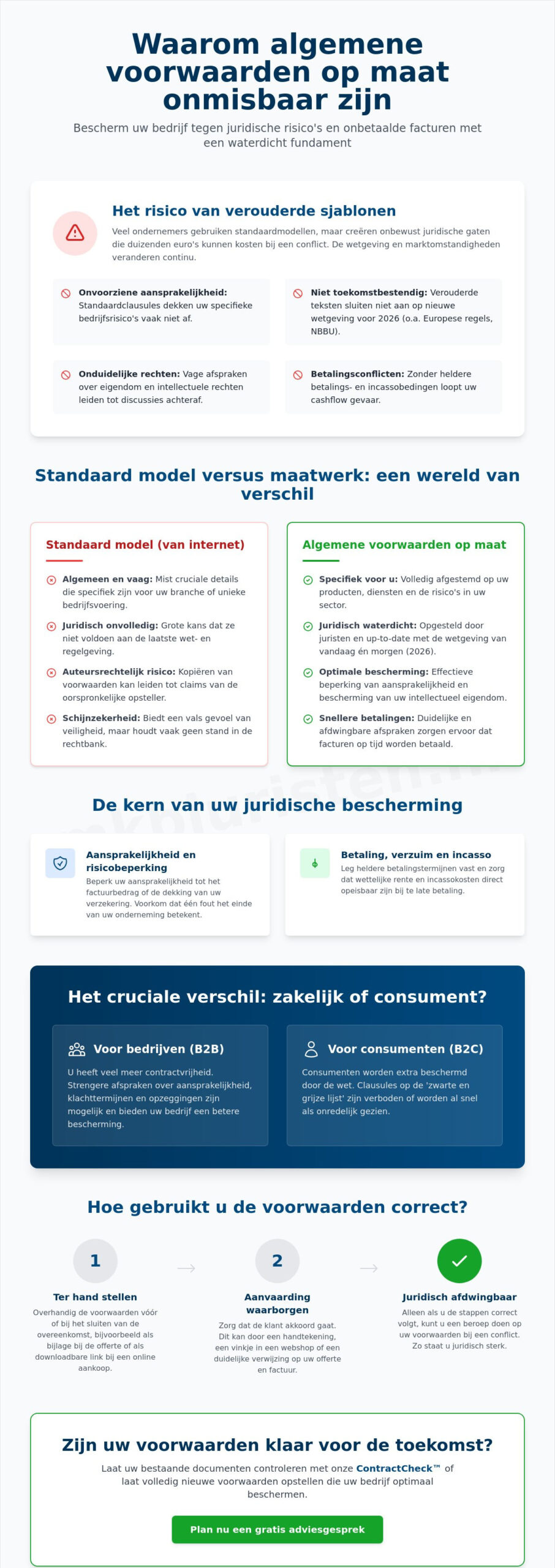
There is a fundamental difference between the main agreement and the general terms and conditions. In the agreement, you define the core: which product or service you provide and at what price. The general terms and conditions regulate everything surrounding this, such as liability, payment terms, and intellectual property. Many entrepreneurs make the mistake of picking a standard template from the internet. However, these templates often lack crucial details. Consider, for example, the new regulations for 2026 within the temporary employment sector via the NBBU or the stricter European rules for online subscriptions. A standard text does not protect you against these specific changes, creating legal loopholes that could cost you thousands of euros in the event of a dispute.
The legal basis of your business
Oral agreements are legally valid in the Netherlands, but they are notorious for the problems they pose as proof. Your terms and conditions act as a professional safety net when an oral promise is no longer sufficient. By consistently applying the same terms to every transaction, you create clarity for both yourself and your client. It prevents you from having to reinvent the wheel regarding the legal framework for every new project. General terms and conditions form the basis of professional risk management.
Business customers versus consumers
The law protects consumers much more strictly than business parties. The Civil Code contains the so-called black and grey lists. These are clauses that are prohibited for consumers or are presumed to be unreasonable. Do you work primarily with other companies? Then you benefit from much greater contractual freedom. For example, you can make stricter agreements regarding liability or notice periods. It is a significant risk to use terms and conditions intended for consumers in a B2B environment; you unintentionally give away rights that you are not legally required to offer. For optimal protection, please visit our page on custom general terms and conditions to see which variant best suits your client group.
The most important clauses in your general terms and conditions
A document full of legal text only has value if the right risks are covered. Every entrepreneur operates differently, but certain fundamentals must never be missing to protect your business against unforeseen costs. A handy guide to drafting general terms and conditions from the Chamber of Commerce shows the basics, but for a result that truly holds up in the event of a conflict, tailor-made general terms and conditions the only safe choice. These clauses form the core of your legal armor.
Liability and risk limitation
A single professional error should never mean the end of your business. It is therefore essential to clearly define the distinction between direct damage and indirect damage, such as lost profits or missed opportunities. By limiting your liability to the invoice amount or the maximum payout of your professional liability insurance, you keep the risks manageable. Also, do not forget to include a clear complaint period. If a customer only complains about a delivery months later, it is often impossible for you to determine the cause. A strict complaint period forces customers to respond quickly, which reduces the likelihood of lengthy disputes.
Payment, default and collection
Waiting for your money is frustrating and damaging to your cash flow. In your terms and conditions, you set the exact payment term that suits your business operations. Is this term exceeded? Then the statutory commercial interest and extrajudicial collection costs must be immediately due and payable without you having to send a notice of default first. This significantly speeds up the process when you have to handle the collection of unpaid invoices in a business context. Clear agreements regarding default ensure that customers treat your invoices with higher priority.
What if you deliver goods but payment is delayed? With a retention of title clause, you remain the legal owner of the products until the full invoice has been paid. This gives you the right to reclaim the goods in the event of bankruptcy or non-payment. In 2026, when economic shifts are moving faster than ever, this is an indispensable safety valve for every supplier.
Finally, you must consider force majeure and cancellation. What if you are unable to deliver due to external factors, such as a global supply chain disruption? A good clause prevents you from having to pay compensation for situations beyond your control. Do you want to be sure that your clauses hold up legally? Have your documents checked via a professional ContractCheck™ to close any gaps in your protection.
Tailored general terms and conditions versus a standard model
Why would you invest in a legal document when the internet is full of free templates? It is a tempting thought for many entrepreneurs: just quickly download a model, change the company name, and you're done. However, the reality in 2026 is that this “quick fix” often places a ticking time bomb under your business operations. Free downloads are almost always based on general situations and do not take into account the specific risks of your industry or the very latest legislation, such as the tightened European rules for online subscriptions.
Copying a competitor's terms and conditions is equally risky. Besides the fact that this is simply theft of intellectual property, you are also copying someone else's errors and blind spots. There is a good chance that your competitor's processes operate slightly differently from yours, causing the clauses to vanish into thin air in a lawsuit. Tailor-made general terms and conditions offer you the assurance that every sentence in the document is there for a reason: to protect *your* specific way of working.
Why a model is often insufficient
Standard templates are often “one size fits all,” which in the legal world usually means they don’t really fit anyone well. A major danger is the voidability of clauses. If a clause in your terms and conditions is deemed unreasonably burdensome, a judge can simply strike it out. You are then left without any protection. Would you like an honest picture of the investment required for a watertight document? Then check out our guide on the costs of drafting general terms and conditions for a transparent overview.
The benefits of customization by MKB Juristen
At MKB Juristen, we don't believe in fill-in forms. Our approach begins with a personal intake in which we analyze your business process from start to finish. This provides you with immediate benefits:
- Seamless integration: Your terms and conditions form a logical whole with your quotations and contracts, ensuring no inconsistencies arise.
- Plain language: We translate complex legal jargon into clear language that your clients understand too. This builds trust and prevents irritation during the sales process.
- Direct support: Do you have a question about how to apply a specific clause in practice? We stand by your side as a pragmatic partner.
The costs of custom solutions pale in comparison to the costs of a single lost lawsuit or a series of unpaid invoices that you cannot collect. Especially now that the self-employment deduction will drop sharply to €1,200 in 2026, every euro of profit you make counts. Protect that profit by laying a solid legal foundation from the start. If you also employ staff, it is equally wise to seek timely legal advice on employment law for employers , so that you do not run unnecessary risks in that area either
How to use general terms and conditions correctly
Even the most well-thought-out, tailored general terms and conditions are legally worthless if you do not present them to your client correctly. Many entrepreneurs believe that simply placing a link somewhere at the bottom of their website suffices, but the law imposes stricter requirements. If you do not follow the rules correctly, a judge can simply set your terms aside in the event of a conflict. The correct use of your terms is therefore just as important as the content itself. This process begins with the very first quotation.
The process consists of four crucial steps:
- Step 1: State that your terms and conditions apply in every quotation, order confirmation, and on your website.
- Step 2: Ensure provision. The customer must receive the terms and conditions before or during the conclusion of the agreement.
- Step 3: Determine the order of documents. In practice, a specific agreement in a quotation always takes precedence over the general terms and conditions.
- Step 4: Consider filing your terms and conditions for additional evidential value and professionalism.
The art of handing over
The biggest legal pitfall is the so-called 'providing' of the terms and conditions. For business clients, a link on the website is often not enough, unless the client can immediately save the terms and conditions for later use. You must be able to prove that the client had the opportunity to read the terms. For a digital transaction, you can resolve this by placing a mandatory checkbox next to the order button, whereby the text of the terms and conditions appears immediately on screen or is sent along as a PDF. Build evidence by recording the sending of the terms and conditions in your CRM system or email archive. This prevents a client from claiming later that they were never aware of the fine print.
Filing with the Chamber of Commerce: sense or nonsense?
Is filing general terms and conditions with the Chamber of Commerce mandatory? No, but it is advisable. By filing your terms and conditions with the Chamber of Commerce or the court, the content and effective date are officially established. This offers enormous certainty in the event of disputes regarding which version of the terms and conditions was valid at the time. Moreover, it projects professionalism to your business partners; it shows that you take your risk management seriously. Especially in complex B2B transactions where a lot of money is at stake, this is a small investment that can prevent major headaches.
Do you want to be sure that your presentation of the terms and conditions holds up legally? Have your current process reviewed by an expert and have your terms and conditions legally checked so that you can do business with peace of mind.
Have your general terms and conditions drafted by MKB Juristen
Choosing MKB Juristen means choosing a partner who stands by your side. We do not believe in complicated legal structures that are of no practical use to you. Our approach is down-to-earth, transparent, and fully focused on unburdening you. Everything starts with a personal intake. In this meeting, we discuss not only what you sell, but, more importantly, what your business processes look like on a day-to-day basis. From that foundation, we create tailor-made terms and conditions that truly protect your company against the risks of 2026.
Do you already have documents but doubt whether they still meet current standards? Our ContractCheck™ is specifically designed to optimize your existing terms and conditions. We review your texts against the latest legislation and check whether the clauses still align with your current way of doing business. It is a quick and efficient way to gain certainty without having to reinvent the wheel.
Custom solutions for every sector
Every industry has its own challenges, requiring a specific approach. For trading companies and logistics service providers, for example, we focus on strong, tailor-made delivery terms. In doing so, we focus on limiting transport risks and ensuring watertight retention of title. For the digital world, we offer specialized assistance with creating general terms and conditions for webshops. We ensure that your online store complies with stricter European consumer regulations, while safeguarding your own interests as an entrepreneur. We always ensure that the text remains understandable; after all, unreadable terms only lead to unnecessary questions from your customers.
What makes MKB Juristen unique is that we do not view your terms and conditions as a standalone document. They form an ecosystem with your other contracts. We ensure that your general terms and conditions seamlessly align with your quotations, cooperation agreements, and privacy policy. This integrated approach prevents documents from contradicting one another, which is often the biggest source of legal conflict.
The next step towards legal certainty
Have you just started your business, or do you want to lay a solid legal foundation right from the start? Then you can combine your terms and conditions with a legal business starter package. This package offers everything you need to enter the market professionally and protected. Our legal experts throughout the Netherlands are happy to assist you with a pragmatic approach and a keen eye for detail.
Don't wait until a conflict arises, but get your affairs in order today. Request a no-obligation quote immediately for your customized general terms and conditions and minimize your business risks with the help of the experts at MKB Juristen.
Build a secure legal foundation for your business
The year 2026 brings new challenges for entrepreneurs, from tax changes to stricter European consumer regulations. A solid legal foundation is therefore more important than ever. By opting for tailor-made general terms and conditions, you prevent unclear agreements from leading to unpaid invoices or unnecessary liability. You now have the knowledge not only to select the right clauses but also to present them legally correctly to your business partners and clients.
Do you want the absolute certainty that your documents are truly watertight? As a specialist in SME law since 2009, MKB Juristen has already helped more than 10,000 entrepreneurs with practical and affordable solutions. We maintain transparent rates and speak your language, without unnecessary legal jargon. This way, you know exactly where you stand and can focus fully on the growth of your business.
Have your general terms and conditions custom-drafted by MKB Juristen and continue doing business with peace of mind. We are ready to help you minimize your risks today.
Frequently asked questions about general terms and conditions
Are general terms and conditions legally required for every entrepreneur?
No, there is no legal obligation to use general terms and conditions. However, without these documents, you fall back entirely on the standard rules of the Civil Code, which often offer insufficient protection against specific business risks. Having tailored general terms and conditions ensures legal stability and prevents you from having to renegotiate the basic rules of your partnership in the event of every dispute.
What is the difference between general terms and conditions and a contract?
A contract contains the core agreements unique to one specific deal, such as the price, the product, and the delivery date. General terms and conditions are the 'fine print' that apply to all your transactions. They regulate general matters such as liability, force majeure, and retention of title. By including these matters in your terms and conditions, you keep your contracts and quotations clear and concise for your customers.
Can I copy and modify a competitor's terms and conditions?
We strongly advise against this due to copyright risks and legal loopholes. Firstly, legal texts are protected by copyright, meaning you risk a fine for plagiarism. More importantly, a competitor's terms and conditions are tailored to *their* specific business operations. A 'copy-paste' often leads to inconsistencies with your own quotations and leaves dangerous risks uncovered that you only discover during a conflict.
How often should I have my general terms and conditions reviewed or updated?
We recommend having your terms and conditions reviewed by an expert every two years. Legislation and case law are constantly changing, such as the new rules for the temporary staffing sector in 2026. Furthermore, if your company grows, enters a new market, or starts supplying different products, the documents must be updated. A regular check via our ContractCheck™ prevents you from working with outdated clauses that no longer hold up legally.
What happens if my client uses their own purchasing terms and conditions (battle of forms)?
In the Netherlands, the 'first blow' rule applies: the party that refers to its terms first usually wins. However, if your client immediately and expressly rejects your terms and presents their own purchasing terms, a legal battle ensues. In that case, you must confirm in writing that you supply only under your own terms to prevent the client's terms from unintentionally becoming applicable to the order.
Are my Dutch general terms and conditions also valid for international business?
Your Dutch terms and conditions are valid in principle, provided you have included a clear choice of law and choice of forum clause. In these clauses, you stipulate that Dutch law applies and that the Dutch courts have jurisdiction in the event of disputes. Furthermore, in international trade, it is crucial to provide a professional translation. Merely a link to a Dutch-language document is often insufficient to legally bind foreign customers to your rules.
What should I do if a customer refuses to agree to my terms and conditions?
In that case, you may decide to make deviating arrangements for that specific client in the main agreement. Record these exceptions in writing and explicitly state that the general terms and conditions remain in full force otherwise. However, be cautious about deleting key clauses such as limitations of liability. If a client refuses to agree to reasonable terms, you must weigh whether the risk of the assignment outweighs the profit.
How do I ensure that my terms and conditions are findable on my website?
For good findability, place a clear link in the footer of every page on your website. However, for legal validity, findability alone is not enough; you must also actively 'make them available'. In a webshop, you do this by having the customer agree via a checkbox during the ordering process. Ensure that the customized general terms and conditions are also available for download as a PDF so that the customer can save them. Do you also want to strengthen your evidentiary position in the event of version disputes? Then read more about filing general terms and conditions with the Chamber of Commerce as a strategic step for extra legal certainty.




