

MKB Juristen drafts custom legal documents
It is best not to cobble together or copy important contracts, terms and conditions, and other legal documents yourself. We help entrepreneurs on a budget with customized legal solutions, clear costs upfront, and practical explanations.
- Custom contracts, terms and conditions, and legal documents
- Budget-friendly and clear about the costs upfront
- Request a free consultation or a no-obligation quote
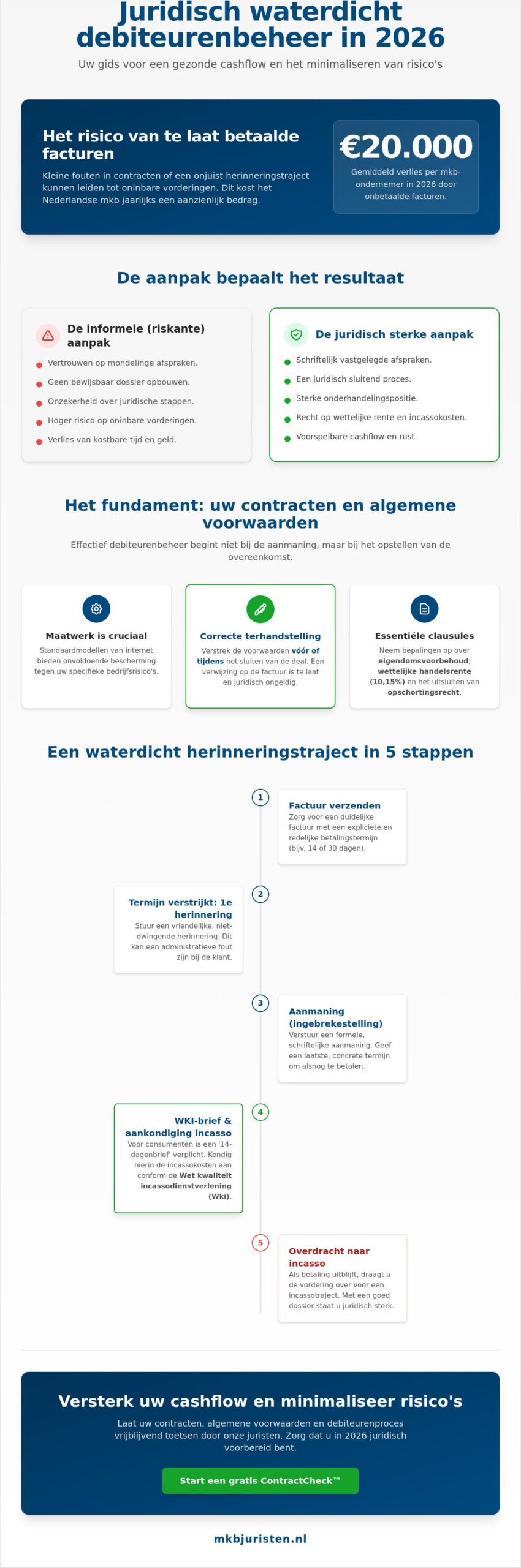
Did you know that by 2026, Dutch SMEs will lose an average of up to €20,000 per year due to invoices being paid late or not at all? It is a frustrating reality: you deliver excellent work, but payment fails to materialize. Often, at that moment, uncertainty arises regarding the legal validity of your reminders, or invoices prove uncollectible due to minor errors in the general terms and conditions. That is precisely why professional debtor management and legal advice are not a luxury, but the foundation of a healthy cash flow for every organization.
We recognize the challenges you face, from the high costs of fruitless collection processes to the time-consuming manual follow-up of arrears. In this article, you will discover how to get your invoices paid faster and minimize risks with the right legal foundation. We offer a clear checklist for 2026 that helps you draft watertight contracts and correctly apply the latest regulations regarding the Debt Collection Services Quality Act (Wki). This allows you to build a predictable process from invoice to payment, so you can once again fully focus on growing your business.
Key Points
- Learn why a solid legal foundation forms the basis for every timely payment and a healthy cash flow.
- Discover how professional debt management legal advice helps you avoid common mistakes in your terms and conditions and contracts.
- Gain insight into setting up a watertight reminder process that fully complies with the legal requirements of 2026.
- Understand when you need to switch to debt collection assistance and how to comply with the rules of the Debt Collection Services Quality Act.
- Receive practical tools to structurally reduce the risk of bad debts without damaging the customer relationship.
What is accounts receivable management and why is legal advice crucial?
What exactly is accounts receivable management? At its core, it encompasses the entire process from the moment you send an invoice until the actual receipt of payment in your bank account. Many entrepreneurs view this purely as an administrative task, but that is a risky misconception. While administrative management revolves around follow-up and keeping track of payment deadlines, legal accounts receivable management focuses on safeguarding your rights. Without the proper legal framework, you are left empty-handed if a customer simply refuses to pay.
Obtaining legal advice regarding debt management is therefore essential to avoid playing catch-up. Simply calling a non-paying customer is often insufficient, as you do not build a verifiable case file in this way. A legal expert looks beyond the administration and focuses on crucial matters such as limitation periods and the legal validity of your notices of default. If a claim ultimately goes to court, only what has been documented in writing and whether you have followed the correct steps count.
The risks of an informal approach
Many entrepreneurs rely on a good relationship and make verbal agreements regarding payments. While this works well as long as everything goes smoothly, it is legally extremely vulnerable. Without written confirmation of a payment arrangement or an acknowledgment of the debt, it becomes difficult to collect a claim if the relationship cools. A lack of structure inevitably leads to claims that prove uncollectible. If your file contains gaps, you will lose valuable time and money in any potential lawsuit. A sloppy approach makes it easy for defaulters to evade their obligations.
Legal benefits of professional management
Professional management offers peace of mind and a strong negotiating position. When your process is legally sound, you can enter into payment arrangements with greater confidence. You know exactly which legal assistance to utilize if agreements are not honored. Moreover, a legally sound process ensures that you can maximize statutory interest and collection costs. This compensates for the costs of the payment delay. Clarity regarding the consequences of non-payment does not harm the relationship; on the contrary, it creates a professional framework in which both parties know where they stand. This prevents unnecessary escalations and keeps the focus on the business partnership.
The legal basis: your contracts and general terms and conditions
Effective accounts receivable management does not start with the first reminder, but long before the invoice is sent out. After all, the legal foundation of your business determines your position if a customer refuses to pay. Many entrepreneurs use standard templates picked up from the internet. The risk is that these documents do not take your specific business risks into account. Customization is the norm here. When you invest in sound legal advice for accounts receivable management, you ensure that your contracts and terms and conditions act as a shield for your cash flow.
A crucial aspect that is often overlooked is the provision of the terms and conditions. No matter how legally strong your terms and conditions may be, if you do not provide them to your client in the right way and at the right time, they are simply not valid. This means that you must hand them over no later than when the agreement is concluded. In most cases, merely referring to them on the invoice is too late. Do you want to be sure that your foundation is rock solid? Then it is wise to have your current general terms and conditions tailored or reviewed against current standards in 2026.
Terms and conditions that truly protect
Good terms and conditions do more than just specify a payment term. For example, they prevent customers from unjustifiably exercising their right of suspension to delay payment. You can also lock in the statutory commercial interest rate, which has been set at 10.15% as of July 1, 2025, to your advantage, or even agree on a higher contractual rate. In addition, retention of title clauses are essential: with these, you remain the owner of delivered goods until the full invoice has been paid. This gives you a huge advantage in the event of bankruptcy or persistent non-payment.
The ContractCheck™ as a preventive tool
It is not only your own terms that matter. You are often presented with contracts from suppliers or major clients that are full of provisions disadvantageous to you. Think of extremely long payment terms or limitations on your right to compensation. By having a contract reviewed by a lawyer via our ContractCheck™, you identify these hidden risks before you sign. It ensures that every agreement you make is actually legally enforceable.
Should a customer fail to pay despite all your precautions, your contracts determine which legal steps you can take in the event of non-payment. By properly arranging your affairs in advance, you significantly lower the threshold for a successful debt collection process. Are you unsure about the validity of your current documents? Then take a critical look at your process on mkbjuristen.nl and avoid surprises afterwards.
Setting up a watertight reminder process
Tight accounts receivable management starts at the source: the invoice itself. If your invoice does not meet legal requirements or contains ambiguities, you unintentionally give the debtor a reason to delay payment. Therefore, ensure that items such as the Chamber of Commerce registration number, VAT number, a clear description of the services, and a clear due date are always included. When the due date passes without payment, it is time to set your process in motion. The goal of legal advice on accounts receivable management is twofold: to maintain the relationship where possible, but to build a rock-solid case file in case things go wrong.
The first step is often a friendly reminder. In this, you assume that the matter is a case of forgetfulness. If payment is still not received after that, the formal demand letter follows. At this stage, it is essential to set a firm deadline. For consumers, the so-called 14-day letter (WIK letter) is even a legal obligation. Without this letter, you simply may not charge collection costs to private individuals. In this letter, you must give the debtor one last chance to pay within fourteen days of delivery of the letter without additional costs, and you must also state the exact amount of collection costs due in the event of non-payment.
Step-by-step plan for the memory cycle
- Days 1-7 after the due date: Send a first friendly reminder via email. For convenience, include a payment link or QR code directly; research from 2026 shows that this significantly increases payment speed.
- Day 14 after the due date: Send a formal reminder. Explicitly announce therein that if payment is not received, the claim will be handed over to a debt collection agency and that additional costs and interest will be charged.
- File building: Record every contact moment, whether it is an email or a phone call, in your CRM system. This logbook is your most important piece of evidence should it come to legal proceedings.
Difference between B2B and B2C memories
It is crucial to distinguish between business customers and consumers. For commercial transactions (B2B), you may charge the statutory commercial interest from the first day after the due date, which has been set at 10.15% as of July 1, 2025. For consumers, the statutory interest of 4% applies (as of January 1, 2026), and the rules regarding collection costs are much stricter. You are bound by the statutory scale, which stipulates a minimum of €40 for claims up to €267. In accordance with Dutch law, a legally valid notice of default must contain a clear demand for payment, granting the debtor a reasonable period to make the payment and explicitly pointing out the legal consequences of failure to do so.
By consistently following this process, you demonstrate that you take your own terms and conditions seriously. This commands respect and ensures that your invoice ends up at the top of the pile. Do you need support in drafting these texts? Our legal assistance helps you set up a process that is both effective and legally sound.
From reminder to collection: legal steps in case of non-payment
When your own efforts do not result in payment, the time has come to hand over the claim. A case is typically ripe for collection assistance as soon as the hard deadline in your final demand letter has passed without result. In 2026, the market for debt collection services will be more transparent than ever thanks to the full implementation of the Debt Collection Services Quality Act (Wki). Since April 1, 2025, all providers must be registered in the national register. This offers you as an entrepreneur the assurance that your partner meets strict quality requirements and integrity standards. Professional debtor management legal advice helps you take the right turn at this stage: do you opt for an amicable process, or is going to court necessary?
In the pre-legal phase, the debtor is given one last chance to pay the principal amount, including statutory interest and collection costs. A demand letter on legal stationery often has significantly more impact than yet another reminder from your own records. It signals that you are prepared to take decisive action. Should this not work, judicial collection proceedings can be initiated. This is particularly worthwhile for larger claims or when there is a substantive dispute that needs to be settled. A legal professional can then have a summons issued on your behalf to obtain an enforceable title. If you want to understand how this process works in practice, read more about legal assistance in cases of non-payment and the concrete steps you can take in 2026 to get your invoices paid.
Transferring your file
For a successful start to your debt collection process, your legal counsel requires a complete file. This begins with the invoice but also includes the underlying agreement and proof that your general terms and conditions were correctly provided. Without these documents, you are in a weaker legal position if the debtor disputes the claim. It is essential that all communication and agreements made are recorded in writing. Do you want to know exactly which steps you need to follow? Then read our guide on starting a business debt collection procedure to avoid delays.
Costs and benefits of legal assistance
Many entrepreneurs hesitate regarding the cost of legal assistance, but in practice, this investment often pays for itself quickly. In the event of successful collection, the collection costs and statutory interest (currently 10.15% for commercial transactions) are recovered from the debtor. The advantage of legal experts over a standard collection agency is their legal depth; we can act immediately if a legal defense arises, whereas an agency often has to stop at that point. You can engage our collection assistance . If you would like a complete overview of your options as an SME entrepreneur, please also consult our comprehensive guide on legal assistance for SME debt collection for a clear picture of the current rules and procedures in 2026.
Do you currently have an outstanding invoice that just isn't getting paid? Don't wait until the claim expires, but let an expert from mkbjuristen.nl review the options for collecting your money.
How MKB Juristen professionalizes your accounts receivable management
Effective debt management is not a matter of chance, but the result of a well-thought-out strategy. Many entrepreneurs perceive the threshold to a large law firm as too high or too formal. At MKB Juristen, we believe in a different approach. We offer you direct access to specialists who speak your language and understand how SMEs operate. Our focus is on reducing risks through pragmatic and accessible legal advice regarding debt management. We look not only at today's outstanding invoice, but at the entire legal structure of your company to prevent problems in the future.
Our approach is characterized by a seamless transition from prevention to action. This often begins with our ContractCheck™, where we analyze your purchase and sales contracts down to the last detail. We identify hidden risks and ensure that your payment agreements are legally enforceable. Should a customer fail to pay despite a watertight contract, we effortlessly switch to collection assistance. Because we are already familiar with your file and your terms and conditions, we can act much faster and more effectively than an external collection agency that has to start from scratch.
Our services for a healthy cash flow
A healthy cash flow is the lifeblood of your business. Research shows that 14.2% of invoices in the SME sector are paid late, which puts your liquidity under immediate pressure. We help you improve these figures by drafting and updating your customized general terms and conditions. Additionally, we support you with complex payment disputes where a standard reminder is no longer sufficient. For new entrepreneurs or companies looking to make a fresh start, our legal business starter package the ideal way to immediately lay a solid foundation.
Make an appointment today
Did you know that a brief scan of your current invoicing process can often yield significant benefits? Small adjustments to the wording of your reminders or tightening your terms of delivery often make the difference between prompt payment and a lengthy process. We invite you to contact us without obligation for an initial consultation. Together, we will explore how to elevate your accounts receivable management to a professional level, without compromising the personal touch or your customer relationships. Contact MKB Juristen and discover how we can unburden you, allowing you to focus once again on what you love most: running your business.
Build a financially healthy future for your company
Effective debt management begins with the quality of your legal foundation. As we have discussed, watertight general terms and conditions and a consistent reminder process are indispensable for protecting your cash flow and preventing bad debts. By complying with the latest legislation of 2026, you not only stand stronger in court; you also command respect from your debtors. In this regard, professional legal advice on debt management is not an expense, but an investment that pays off in peace of mind and liquidity.
Since 2009, MKB Juristen has specialized in supporting SMEs with pragmatic advice free from complex jargon. Our focus is always on achieving results and minimizing your risks. Do you want to be sure that your process is watertight? Have your accounts receivable management legally reviewed by MKB Juristen and prevent losing money unnecessarily. With the right legal steps, you regain full control over your outstanding invoices. We are ready to assist you every step of the way toward better cash flow.
Frequently asked questions about accounts receivable management
What exactly does legal advice on debtor management entail for an SME entrepreneur?
This advice focuses on establishing a watertight process from the initial quotation to final payment. It includes drafting binding contracts, correctly providing general terms and conditions, and building a verifiable file. By seeking legal advice regarding debtor management , you ensure that your claims are not only administratively correct but also legally sound should a customer refuse to pay
When are general terms and conditions legally binding on my debtors?
Your terms and conditions are only binding if you actually provide them to the customer no later than at the time of concluding the agreement. This is known as the duty to inform or the duty to hand over. It is therefore not sufficient to mention them on the invoice only afterwards. For online sales, the customer must be able to save the terms and conditions; for physical transactions, you must hand them over or demonstrably have sent them by email before the order is definitively confirmed.
How much collection costs am I legally allowed to charge a business customer?
For business receivables, you follow the statutory scale (WIK), under which you may charge 15% on the first €2,500 with a minimum of €40. Additionally, for commercial transactions, you are entitled to the statutory commercial interest rate of 10.15% (percentage as of July 2025). You can often make more favorable agreements regarding collection costs and interest in your general terms and conditions, provided these remain reasonable and are correctly stipulated in the contract.
Is a written notice of default always required before I start a collection procedure?
For consumers, a written 14-day notice (WIK letter) is legally required to claim collection costs. For business clients, default often occurs automatically after the payment term has expired, provided this is stipulated in your agreement. Nevertheless, we always recommend sending a formal demand letter. This strengthens your position and serves as irrefutable proof of your efforts in any potential legal proceedings.
What is the difference between a debt collection agency and legal debt collection assistance?
A debt collection agency focuses primarily on sending reminders and collecting undisputed claims during the amicable phase. Legal debt collection assistance goes a step further; we can also advise on substantive disputes and litigate on your behalf in court. While an agency often stops when a debtor raises a substantive defense, our legal experts press on to secure your rights through judicial proceedings or seizure of assets.
How do I prevent my claims from becoming time-barred under Dutch law?
Most business claims become time-barred five years after the invoice becomes due. You prevent the statute of limitations from expiring by interrupting this period in a timely manner with a written notice in which you unequivocally reserve your right to payment. It is essential to send this letter of interruption by registered mail or to have its receipt confirmed. This way, the five-year limitation period starts running again, and your claim remains legally enforceable.
Can I recover legal costs from a debtor who does not pay?
Yes, you can recover the statutory collection costs and interest directly from the debtor as part of the claim. In legal proceedings, the judge decides on the legal costs. Usually, the losing party is ordered to pay a fixed fee for the legal costs incurred (the liquidation rate) and court fees. Although this does not always cover the full actual costs, it compensates for a significant portion of your investment in professional assistance.
What should I do if a customer disputes the invoice to avoid payment?
Immediately request a written and substantiated explanation of the dispute from the debtor. Subsequently, analyze whether the complaint is justified based on the contractual agreements made and your general terms and conditions. If the defense proves unfounded, you can proceed with the collection procedure immediately. In the case of complex disputes, it is advisable to seek legal advice immediately; we will assess the feasibility of your case and assist you in strongly refuting unjustified claims.




