

MKB Juristen drafts custom legal documents
It is best not to cobble together or copy important contracts, terms and conditions, and other legal documents yourself. We help entrepreneurs on a budget with customized legal solutions, clear costs upfront, and practical explanations.
- Custom contracts, terms and conditions, and legal documents
- Budget-friendly and clear about the costs upfront
- Request a free consultation or a no-obligation quote
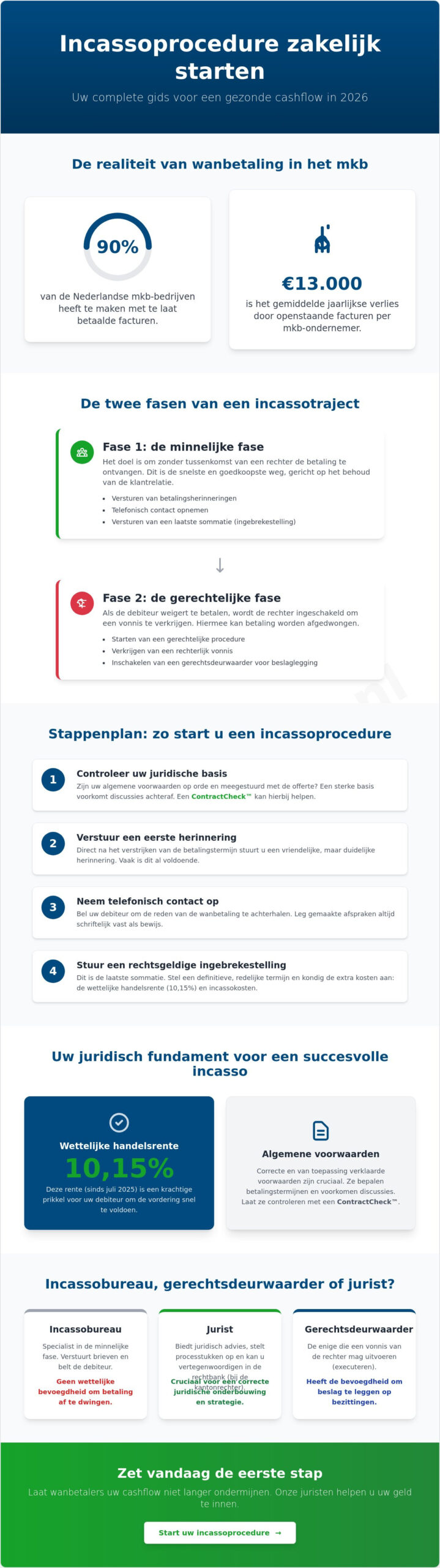
Did you know that no less than 90% of Dutch SMEs regularly deal with late-paid invoices? This is a frustrating reality that costs entrepreneurs an average of €13,000 in lost revenue annually. You want to invest your time and energy in growing your business, not in endlessly chasing payments to which you are simply entitled. Uncertainty regarding legal deadlines and the fear of high legal costs often make the threshold for initiating business debt collection proceedings unnecessarily high.
We understand that you are looking for a solution that delivers results without immediately jeopardizing the customer relationship. In this guide for 2026, you will discover how to get your outstanding invoices paid faster, step by step, and restore your cash flow to a healthy state. We provide the necessary clarity regarding current regulations, such as the statutory commercial interest rate of 10.15% and the proper deployment of collection assistance. From the first reminder to proceedings before the sub-district court, you will receive a clear overview of all actions you can take today.
Key Points
- Understand the crucial difference between the amicable and judicial phases to collect your claim efficiently and without a judge.
- Discover why a bailiff has more powers than a collection agency and when to hire a lawyer.
- Learn how to initiate a business debt collection procedure with a clear step-by-step plan, starting with a review of your general terms and conditions.
- See how a ContractCheck™ strengthens your legal position and helps prevent unnecessary disputes regarding payment terms.
- Gain insight into drafting a legally valid notice of default that meets the latest legal requirements for 2026.
What is a business debt collection procedure and when do you start it?
A business debt collection procedure is the structured process of recovering debts whereby you compel another company to pay an overdue invoice. It is much more than just sending an angry email. It is a legal process aimed at receiving your rightful money while minimizing risks. An invoice is officially considered due as soon as the agreed payment term has expired. Has no term been agreed? Then, in the Netherlands, a statutory term of 30 days applies. For many entrepreneurs in the SME sector, non-payment is a silent killer of liquidity. On average, an SME entrepreneur loses €13,000 annually due to outstanding receivables, which has direct consequences for your own investment capacity and the payment of your staff.
Within the process, we make a clear distinction between the amicable and the judicial phases. In the amicable phase, you attempt to arrange payment through reminders and demands without the intervention of a judge. This is often the fastest and cheapest route. However, should your debtor persistently refuse, judicial collection follows. In this stage, you ask the judge for an official judgment. At this stage, the role of the bailiff crucial, as only they have the legal authority to actually seize bank accounts or assets following a judgment.
The importance of proactive accounts receivable management
Delaying collection is one of the biggest mistakes you can make. The older a claim, the smaller the chance that you will ever see the full amount. A tight reminder cycle is therefore essential. Start with a friendly reminder immediately after the due date has passed, followed by a formal demand letter. It is about finding the balance between customer friendliness and business clarity. By using a fixed structure, your customers know that you take your invoicing seriously. This lowers the threshold for them to place your invoice at the top of the pile from now on. If you wish to further professionalize your approach, Debtor Management Legal Advice a complete checklist to set up a legally watertight reminder cycle.
Legal frameworks for business claims
When initiating a business debt collection procedure, different rules apply than for consumers. The Debt Collection Costs Act (WIK) provides a framework for the fees you may charge for collection activities. A major advantage in the business market is speed. While you are required to send a 14-day notice to consumers, you can often act more directly with companies once the payment term has expired, provided this is properly stipulated in your general terms and conditions. Furthermore, since July 2025, the statutory commercial interest rate is 10.15%, which provides an additional incentive for your debtor to pay quickly. However, everything depends on correct invoicing that complies with all legal requirements.
The different phases of a debt collection process explained
A debt collection process follows a fixed pattern that you go through step by step. The goal is simple: to receive your money without unnecessarily damaging the relationship with your customer. Starting a business debt collection procedure almost always begins with the amicable phase, but can escalate into an enforcement process in which a bailiff actually proceeds to seize assets. By understanding this process, you maintain control and prevent a case from remaining dormant for an unnecessarily long time. The process is designed to gradually increase pressure, with legal certainty being paramount.
The amicable phase: speed and preservation of the relationship
In this first phase, everything revolves around communication and speed. You send a first and possibly a second payment reminder. It is advisable to also make contact by telephone after the first reminder. Sometimes it is simply a matter of an administrative error or a temporary liquidity problem. By calling, you uncover the real reason for the non-payment. Immediately record all agreements made during such a conversation in writing. This is crucial if the debtor disputes the claim later; you then have proof of the acknowledgment of the debt. Should a customer unjustifiably complain about the services provided in order to avoid payment, you will be in a stronger position with a well-constructed file.
Following the reminders, the pre-legal phase ensues. In this phase, you send the final demand letter, setting a definitive deadline for payment for the debtor. In this letter, you also announce the additional costs the debtor will have to pay if payment is not received. These include extrajudicial collection costs (WIK) and statutory commercial interest, which has stood at 10.15% for business transactions since July 2025. This step is essential to officially place the debtor in default and pave the way for further legal action.
The step to the sub-district court
When amicable attempts and a formal notice of default yield no results, going to the sub-district court is the next logical step. A legal expert can assist you with this by drafting a summons and conducting the proceedings. For claims up to €25,000, the sub-district court is the designated authority. You are not required to engage a lawyer in this case, which makes the procedure more accessible to SMEs. However, do take into account the court fees for 2026. For example, for a business claim between €1,500 and €2,500, you pay €397 to the court, while for claims exceeding €12,500, this rises to €1,504.
The ultimate goal of this legal path is obtaining a judgment, also known as an enforceable title. With this document in hand, you can start the execution phase. Only at this stage can a bailiff take coercive measures, such as wage garnishment or seizure of the business bank account. Do you want to prevent it from coming to that point? Professional debt collection assistance helps you exert the right legal pressure in the early stages, often making a court appearance unnecessary.
Collection agency, bailiff, or lawyer: the differences
Who will help you get your money? When you want to start a business debt collection procedure, you will quickly encounter three different parties. Although they all have the same goal, their means and powers differ significantly. A debt collection agency is often the most accessible step, but they have no coercive legal power whatsoever. They may send letters and make phone calls, but they cannot force a debtor to pay. For persistent defaulters, a debt collection agency is therefore often nothing more than a temporary delaying tactic.
A court bailiff, on the other hand, does possess statutory powers. They can serve summonses and, once a judgment has been rendered, seize bank accounts or assets. However, the bailiff is often less effective during the amicable phase because they are independent office holders. They do not stand alongside you as an advisor, but operate as a neutral intermediary. This is precisely where the added value of a legal expert lies. A legal expert combines the persistence of a debt collection agency with the legal knowledge required to convince a sub-district court judge.
Why debt collection assistance from a lawyer pays off
If you opt for debt collection assistance from a legal expert, the process begins with a thorough legal screening. We immediately assess whether your claim is strong enough to preempt any potential defense. By establishing a direct link with your general terms and conditions, we ensure that you can claim the maximum compensation for collection costs and interest. Unlike the often automated letters from large collection agencies, you receive a personal approach from us. We understand how business works and know when to apply pressure without irreparably damaging the business relationship.
Bailiffs and their statutory duties
The bailiff usually only comes into the picture once the amicable phase has been concluded. Their role is essential for serving the summons and officially serving judgments. Only after the judge has made a ruling can the bailiff carry out their statutory duties, such as seizing assets. It is a misconception that you immediately need a bailiff to start a business debt collection procedure. In most cases, a strong demand letter from a lawyer is sufficient to induce the debtor to pay, saving you significant bailiff costs.
Regarding costs, you often see no-cure-no-pay structures among collection agencies in the market. While this sounds attractive, it often means the agency stops as soon as the case becomes difficult. We believe in transparency and work with clear rates for our services. This ensures you know exactly where you stand and are assured of a lawyer who will go to the extreme, even if the debtor puts up a fight.
Step-by-step plan: how to start a business debt collection procedure
Successful debt collection hinges on careful preparation. You not only want to receive your money but also prevent a judge from dismissing your claim later due to procedural errors. Initiating a business debt collection procedure requires a methodical approach ensuring your evidence is in order from the very beginning. Follow these five steps to maximize your position:
- Step 1: Check your contract. Get out the signed quotation or agreement. Are all agreements regarding delivery and payment terms in writing?
- Step 2: Send a formal notice of default. This is the official starting signal. You give the debtor one last chance to pay before additional costs are charged.
- Step 3: Calculate the interest and costs. In 2026, you may charge a statutory commercial interest rate of 10.15% for business receivables. Add the collection costs according to the statutory scale to this.
- Step 4: Assemble a file. Gather the invoice, proof of delivery of reminders, and any correspondence in which the debtor acknowledges the debt.
- Step 5: Transfer the claim. Did the final demand yield no results? Then immediately engage a legal expert to increase the pressure.
Writing the perfect notice of default
In the business-to-business (B2B) market, different unwritten rules apply than with consumers. While you are required to grant a period of 14 days for a consumer, a period of 5 working days after receipt of the letter is customary and acceptable in business dealings. Be crystal clear in this letter. State the exact invoice number, the outstanding amount, and the deadline by which the money must be in your account. Explicitly refer to the applicable general terms and conditions to prevent disputes regarding the validity of your collection costs. A clear warning regarding the legal steps to be taken is often sufficient to expedite payment.
Calculate costs and interest in 2026
Claiming additional costs is not a favor, but a right. Since July 2025, the statutory commercial interest rate has been set at 10.15%, which is significantly higher than the interest rate for consumer transactions. The Debt Collection Costs Act (WIK) applies to extrajudicial collection costs. This means that you may charge 15% in costs on the first €2,500 of the principal amount, with a minimum of €40. It is essential that you explicitly claim these costs and accrued interest in your final demand letter. If you fail to do so, a judge cannot simply award them later. Do you want to be certain that your claim meets all legal requirements? Let our experts handle your collection assistance and avoid missing out on potential savings.
The legal basis for successful debt collection
Many entrepreneurs only consider starting a business debt collection procedure when an invoice is already months overdue. However, the foundation for prompt payment is laid much earlier, namely in the documents you share before the assignment begins. A strong legal basis ensures that you are not left empty-handed in the event of non-payment and can take immediate action. It gives you the peace of mind that your claim is legally sound, which significantly lowers the threshold for taking action.
An essential part of this foundation is the ContractCheck™. With this, we have your current agreements checked for weaknesses. For instance, a clearly agreed payment term is crucial to be able to immediately place a debtor in default. In addition, retention of title is a powerful tool against non-paying customers. With this, the delivered goods remain your property until the last cent has been paid. For new entrepreneurs, a legal starter package often the best way to minimize non-payment from day one.
Watertight terms and conditions
Your general terms and conditions are the backbone of your collection policy. In the business market, you have the freedom to include provisions regarding collection costs and interest that deviate from standard statutory rules, provided this is reasonable. For example, you can exclude the customer's right of suspension. This prevents a customer from putting an entire invoice “on hold” due to a minor detail or an unrelated complaint. Do not forget that these terms only apply if you have correctly provided them when concluding the agreement. A simple reference on the invoice is often not sufficient to offer legal certainty.
Prevention through legal advice
Prevention is still more efficient than cure. Before accepting a major new business client, a brief risk analysis can save you a lot of trouble. Do you always work with a signed contract for services? This document is your most important piece of evidence should you ultimately need to initiate business debt collection proceedings. In practice, a signed signature on a quotation is much more powerful than a verbal promise over the phone. If you want to know how to optimally protect your working capital, read more about legal assistance in cases of non-payment and the current regulations for 2026.
Do you have doubts about the legal structure of your business operations, or would you like to have your current contracts updated to 2026 standards? Then contact MKB Juristen for a preventive check. We stand by your side as a pragmatic partner to mitigate your risks and protect your cash flow, so that you can focus on the growth of your business without worry.
Take back control of your cash flow today
Collecting outstanding invoices does not have to be a frustrating or drawn-out process. By ensuring watertight general terms and conditions and a tight reminder cycle, you lay a solid foundation that you can always fall back on. Initiating a business debt collection procedure is a necessary step to safeguard the liquidity and health of your company. You are simply entitled to payment for the work you have delivered, and in 2026, the law offers you ample scope to effectively claim this right.
Do you no longer want to wait for your money and would you rather outsource the legal hassle to an expert? Start your debt collection procedure today with the help of MKB Juristen. We have been the trusted legal partner for SME entrepreneurs since 2009. With us, you won't find dusty jargon, but practical language and a down-to-earth approach that delivers results. We stand by your side to complete the process professionally, so that you can fully focus on your own ambitions again. Together, we ensure that your invoices are no longer left unpaid.
Frequently asked questions about business debt collection
How long does a business debt collection procedure take on average?
An amicable procedure usually takes two to four weeks. During this phase, we attempt to settle the payment without involving a judge. Should recourse to the sub-district court be necessary, you should expect a process lasting several months to a year. The total duration depends heavily on the willingness of your debtor and whether the claim is disputed on its merits.
What are the costs of a business debt collection procedure?
The costs consist of extrajudicial collection costs, court fees, and compensation for legal assistance. When initiating commercial debt collection proceedings, the collection costs and interest are, in principle, recovered from the debtor. At the sub-district court, in 2026 you pay court fees ranging from €139 for small claims to €1,504 for claims exceeding €12,500.
Can I always recover collection costs from my business client?
Yes, for business transactions, you can charge collection costs as soon as the agreed payment term has expired. The statutory minimum is €40 according to the scale of the Collection Costs Act. However, it is essential that you explicitly claim these costs in your demand letter. Furthermore, you can often agree on higher fees than the statutory standard through your general terms and conditions.
What is the difference between commercial interest and statutory interest?
The main difference lies in the percentage and the target group of the transaction. The statutory commercial interest rate applies specifically to business agreements and has stood at 10.15% since July 2025. The standard statutory interest rate is intended for transactions with consumers and amounts to 4% in 2026. The commercial interest rate is therefore a much more powerful tool to force business defaulters to take action.
When is a notice of default required in business debt collection?
A notice of default is mandatory if no fixed payment deadline has been agreed upon in the contract. Even if a clear deadline is stated in your contract, sending a formal demand is always advisable. It serves as irrefutable proof that the debtor is in default. This document forms the legal basis for claiming interest and costs.
What should I do if my client disputes the invoice?
In the case of a disputed invoice, you must first seriously assess the customer's substantive objections. Is the complaint unfounded, or is it merely being used as a delaying tactic? If so, you can initiate the debt collection procedure on a business basis and refute the defense during the proceedings. If a complaint is well-founded, we recommend reaching a settlement first before incurring further legal costs.
Can I start a debt collection procedure myself without a lawyer?
You can litigate yourself before the sub-district court for amounts up to €25,000. However, this is not without risk, as procedural errors in the summons can lead to the rejection of your claim. A legal expert is familiar with the rules of procedure and ensures that your case file is legally sound from the very first demand letter. This significantly increases the chance of a successful judgment.
How does seizure work for a business debtor?
Attachment can only be carried out by a bailiff after the judge has issued a judgment. The bailiff can then take coercive measures, such as seizing bank accounts or business inventory. This is the last resort to recover your money if the debtor refuses to pay voluntarily even after a court ruling.




