

MKB Juristen drafts custom legal documents
It is best not to cobble together or copy important contracts, terms and conditions, and other legal documents yourself. We help entrepreneurs on a budget with customized legal solutions, clear costs upfront, and practical explanations.
- Custom contracts, terms and conditions, and legal documents
- Budget-friendly and clear about the costs upfront
- Request a free consultation or a no-obligation quote
What are general terms and conditions for graphic designers? They are the standard rules that you, as a designer, declare applicable to every assignment in advance, so that you do not have to renegotiate copyright, usage rights, revision rounds, delivery, and payment with every client. For a graphic designer, it is primarily about one thing: who receives which rights to the design, and under what conditions. Without clear terms, you unintentionally sell away your copyright or deliver source files that you never intended to hand over.
The short answer
- What: the standard rules that you declare applicable to every design assignment.
- Key takeaway for designers: copyright remains with you, the client receives a defined right of use.
- Further handles: number of revision rounds, what constitutes a good briefing, delivery, source files, and payment.
- Legal status: valid if the client could have known it before or at the time of concluding the contract.
- Why: prevents discussions about reusing your design and endless modifications.
What exactly are the general terms and conditions for graphic designers?

General terms and conditions are neither a quotation nor an order confirmation. They are the fixed legal framework underlying all your assignments. The quotation states what you create and what it costs; the terms and conditions state the rules governing this. For a graphic designer, the vast majority of those rules concern intellectual property — and that is precisely where things go wrong in design work.
A logo, corporate identity, packaging design, or printed matter is protected by copyright as soon as it is sufficiently original. That copyright arises automatically with you as the creator. The client pays for the design, but legally, this does not mean that they are purchasing the copyright. Without an agreement, the client only acquires the right to use the delivered work as intended — not to modify it, resell it, or reuse it everywhere. Your terms and conditions make this explicit.
Copyright: the core of the design profession
The distinction that every designer must be clear is that between copyright and the right of use (license).
- Copyright is ownership of the design. Whoever holds the copyright may reproduce, modify, and exploit the design. In your terms and conditions, you retain this ownership by default.
- The right of use is the license you grant to the client: the right to use the design for the agreed purpose. You define the scope — for which communications, which medium, which territory, and which duration.
- Copyright can be transferred , but only in writing and usually at an additional cost. If the client wishes to own the logo outright, this is a separate agreement, not an automatic consequence of payment
A client who “buys the logo” is, in principle, therefore buying a right of use, not the copyright. Anyone who fails to record this will face disputes later on, as soon as the client has the design modified by someone else or uses it for something completely different.
What a good set of conditions regulates

In addition to copyright, a strong set of conditions for a designer covers the practical side of the design process:
- Briefing and assumptions. You work based on the provided briefing. If information is missing, you may rely on reasonable assumptions; subsequent course corrections constitute additional work.
- Revision rounds. You determine how many correction rounds are included in the price (for example, two) and that extra rounds are charged at an hourly rate. This is the most important brake on endlessly shifting colors and fonts.
- Supplied material. The client guarantees that texts, photos, and logos supplied by him are free from third-party rights and indemnifies you against claims.
- Delivery. What do you deliver: only print-ready or web exports (PDF, PNG, JPG), or also the editable source files?
- Source files. Working files (AI, PSD, INDD, figma sources) are supplied only by separate agreement and usually at an additional cost — they contain your working method and make you replaceable.
- Payment and retention of title. Payment term, any down payment, and the right of use which only transfers after full payment.
- Attribution and portfolio. The right to display the work in your portfolio.
How does this differ from a photographer?
Photographers and designers share the basic principle of copyright, but practice differs. For a photographer, the license revolves around an existing image: where, for how long, and in which medium the photo may be used. For a graphic designer, it concerns a design that the client often wants to develop further — a corporate identity grows with the organization.
As a result, two points carry more weight for a graphic designer: the right to modify (can the client adjust the logo themselves or through another party?) and the source files (can the client proceed without you at all?). A good set of terms and conditions for a graphic designer explicitly regulates these two, whereas a photography contract hardly needs to.
Legal status: when do they apply?
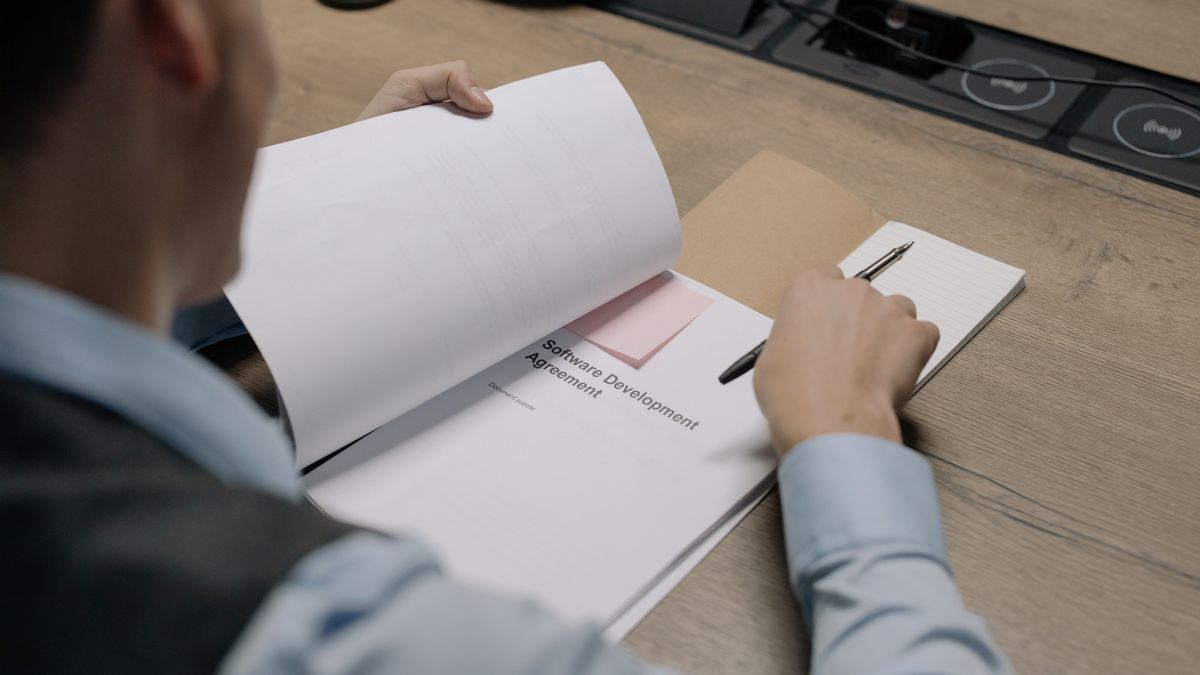
Terms and conditions only bind the customer if you declare them applicable in a timely manner and the customer could reasonably have been aware of them. In practice, this means:
- Refer to it in your quotation and order confirmation.
- Provide them before or at the latest upon closing the assignment — usually as a PDF attachment or via a clear link.
- Do not wait until after the fact to add that to the invoice; in principle, they do not apply to that assignment then.
If you work for consumers (private individuals), the statutory grey and black lists also apply: certain clauses are not permitted or are presumed to be unreasonably burdensome. If you work commercially (B2B), you have more leeway, but unreasonable clauses can still be annulled.
Brief practical example
A freelance graphic designer creates a corporate identity for a local hospitality business and delivers clean PDF exports. A year later, the client opens a second location, has a cheaper party “just adjust” the logo, and uses it everywhere. Because the terms stipulated that the copyright remained with the designer, modifications were not permitted, and source files had not been provided, the designer was able to settle the matter amicably: a license extension and compensation for the source files, instead of an unsound dispute.
Honest recommendation

As a graphic designer, you need general terms and conditions as soon as you deliver paid design work — copyright and source files are simply too valuable to leave unregulated. You do not need a lawyer for every assignment: a good, standardized set that you declare applicable to every assignment covers the vast majority. A lawyer is particularly useful for drafting that set once, and for deviating agreements such as the full transfer of copyright or an exclusive license for one major client. For standard assignments, it is subsequently a matter of consistently referring to and including them.
Read more: drafting and having general terms and conditions drafted for a graphic designer : costs and process . Need a ready-made version? View the general terms and conditions for graphic designers .
Frequently Asked Questions
These are the standard rules that you declare applicable to every design assignment. They primarily regulate who holds the copyright, what usage rights the client receives, how many revision rounds are included, how you deliver, and whether source files are provided, plus payment. This way, you do not have to renegotiate for each client.
No, not automatically. Copyright originates with you as the creator and remains with you, unless you transfer it in writing. The paying client generally receives a right of use (license) for the agreed purpose — not ownership of the design. Transfer is a separate agreement, often at an additional cost.
With a right of use (license), the client may use the design within the defined limits: medium, territory, and duration; the copyright remains with you. Upon transfer, you fully transfer the copyright and lose the rights to the design yourself. Transfer can only be done in writing and is usually more expensive.
Not standard. In your terms and conditions, you normally provide print-ready or web exports (PDF, PNG, JPG). You only provide editable source files (AI, PSD, INDD) by separate agreement and usually at an additional cost. Source files allow the client to continue working without you, so you treat them as a separate component.
You decide this yourself, but put it in writing — for example, two rounds of revisions included in the price and extra rounds at an hourly rate. Without an agreement, the client will endlessly rearrange colors and text. A clear revision limit in your terms keeps the project affordable and manageable.
Only if you declare them applicable before or at the conclusion of the contract and the client could reasonably have been aware of them. Refer to them in your quotation and send them along as a PDF or via a link. Conditions that only appear on the invoice do not, in principle, apply to that assignment.
The basic principle regarding copyright is the same, but for a designer, two points carry more weight: the right to modify the design (can the client have the logo changed?) and the source files (can he continue without you?). A corporate identity grows with the organization, so you regulate those two explicitly — whereas with a photography contract, that is hardly necessary.


