

MKB Juristen drafts custom legal documents
It is best not to cobble together or copy important contracts, terms and conditions, and other legal documents yourself. We help entrepreneurs on a budget with customized legal solutions, clear costs upfront, and practical explanations.
- Custom contracts, terms and conditions, and legal documents
- Budget-friendly and clear about the costs upfront
- Request a free consultation or a no-obligation quote
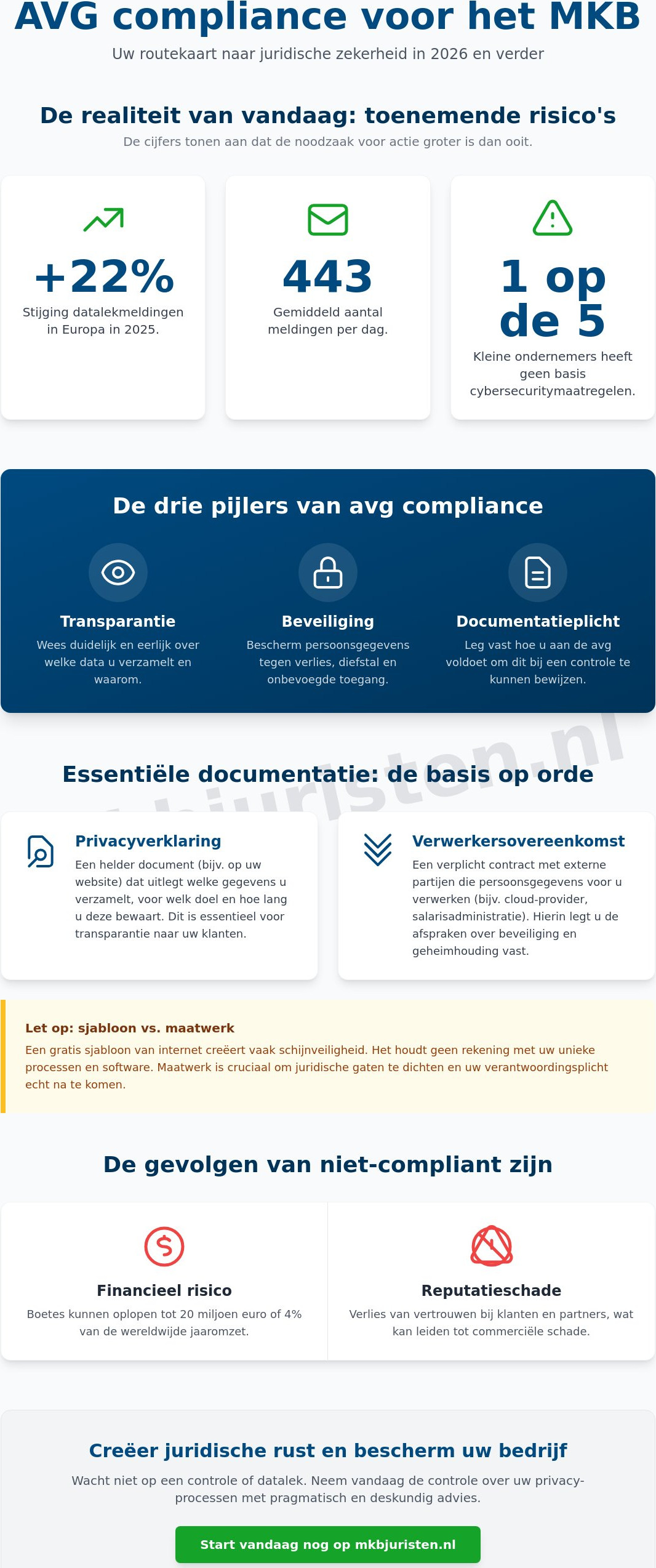
Did you know that the number of data breach notifications in Europe has risen by no less than 22% in 2025 to an average of 443 notifications per day? While risks are increasing, one in five small business owners in the Netherlands has not yet taken a single basic cybersecurity measure. Arranging GDPR compliance for SMEs often feels like an impossible task due to the lack of clarity regarding mandatory documents and the fear of hefty fines from the Dutch Data Protection Authority.
It is only logical that you would rather spend your time growing your business than figuring out complex legislation. We understand that you need down-to-earth solutions and legal certainty during audits. In this article, you will discover how to easily and legally prepare your company for the 2026 privacy legislation without unnecessary complexity. We provide a clear list of obligations and present practical documents that you can use immediately to get your affairs in order today.
Key Points
- Learn why 2026 is the year enforcement intensifies for smaller businesses and what this means for your risk management.
- Identify the essential documents you need to have on hand to meet legal requirements without unnecessary administrative burdens.
- Discover how to easily achieve GDPR compliance as an SME by focusing on what is reasonable and necessary for your specific business size.
- Gain insight into a clear step-by-step plan for a watertight scan that allows you to immediately get a grip on the data flows within your organization.
- Experience how you create legal peace of mind and protect your business against unexpected inspections with pragmatic, tailored GDPR and privacy documentation.
What exactly does GDPR compliance for SMEs entail?
Understanding privacy legislation, or " What is the GDPR?", is for many entrepreneurs the start of a search through a legal maze. At its core, this legislation revolves around the careful handling of information relating to natural persons. For your company, this means you must be able to demonstrate that you take the privacy of customers and staff seriously. In 2026, the era of optionality will be definitively over. The Data Protection Authority is increasingly targeting the resilience gap between large organizations and small and medium-sized enterprises (SMEs). While large players often already have their affairs in order, figures from 2025 show that one in five small SMEs has not yet taken a single basic measure. GDPR compliance for SMEs is therefore no longer a paper tiger, but a necessary condition for continuing to operate commercially.
Compliance rests on three key pillars. First, there is transparency: you explain what you do with data. Second, security: you protect the information from unauthorized persons. Finally, there is the documentation obligation: you record your processes in writing. In daily practice, this means that a privacy statement on your website alone is not enough. It is about the actions behind it and the proof that you are in control.
When are you compliant as an SME entrepreneur?
You are only truly compliant when you have full control over the data flows within your organization. This starts with an inventory: what data comes in and where does it end up? Compliance is not a one-off project that you simply tick off. It is an ongoing process. The world changes, your software receives updates, and your team grows. In the Netherlands whether companies have their processes in order. Although the regulator takes proportionality into account for SMEs, it is expected that the foundation is in place. You must be able to demonstrate at any time why you retain certain data and how you secure it.
The consequences of being non-compliant
The fear of fines is often the biggest driving force for entrepreneurs. Although the regulator can impose fines of up to 20 million euros, the reputational damage is often even more damaging. With a 22% increase in the number of daily data breaches projected for 2025, the likelihood of an incident is real. If you fail to report a data breach in a timely manner or if your documentation is missing, you will lose the trust of your market. Do you know what to do if things do go wrong? Then read more about legal advice regarding data breaches and the steps you, as an entrepreneur, must take in the event of a security incident. In the B2B sector, GDPR compliance for SMEs has become a strict requirement. Clients want to see proof that their data is safe with you before signing a contract. Without the right legal support, you therefore run not only a legal but also a commercial risk.
The essential GDPR documentation for your business
Many entrepreneurs reach for a free template from the internet to quickly get rid of the “GDPR hassle.” While this seems like a solution on paper, in practice it often creates a dangerous false sense of security. A standard model fails to take into account the unique software you use or the specific way your staff handles customer data. For effective GDPR compliance for SMEs, it is crucial that your documentation is an honest reflection of your business operations. The heart of the legislation is accountability. You must not only follow the rules, but you must also be able to prove it with documents that align with your daily reality.
According to the Dutch Data Protection Authority, documenting processes is the only way to demonstrate that you handle personal data with care. When you opt for customization instead of a generic template, you reduce the risk of legal loopholes that become immediately apparent during an audit or data breach. It gives you peace of mind knowing exactly what is stated in your contracts and why certain choices were made.
Privacy Statement and Data Processing Agreement
a privacy statement drafted involves more than simply placing a short text on your website. It must clearly describe what data you collect, how long you retain it, and for what specific purpose. Furthermore, you are often dependent on external parties, such as a cloud provider or a payroll administrator. In those cases, drafting a data processing agreement mandatory. This ensures that your partners also handle your data securely. Without these agreements, you, as an entrepreneur, are fully liable for errors made by third parties.
The register of processing activities
a register of processing activities sounds like a heavy administrative burden, but it doesn't have to be. In this document, you simply record which categories of data you process and who has access to them. It is the blueprint of your data flows. By keeping this register up to date, you can immediately see where potential risks lie and act faster in the event of a data breach. It is a living document that must grow with your business. Do you want to be sure your foundation is solid? A check of your GDPR and privacy documentation can eliminate a lot of uncertainty.
Why many SME entrepreneurs struggle with privacy legislation
Many entrepreneurs still believe that privacy law is intended only for tech giants like Google or Meta. That is a misconception. The official GDPR rules for businesses make no distinction between a multinational and a local freelancer once names and addresses are stored in a system. This belief creates a false sense of security. The consequence? GDPR compliance for SMEs is placed at the bottom of the priority list, while the risks for smaller companies are actually greater because they often have fewer reserves to absorb incidents.
The biggest hurdle is often the gap between legal jargon and daily practice in the workplace. Terms like 'data controller' or 'pseudonymization' are off-putting. Entrepreneurs want to do what they are good at: doing business. Legislation can then quickly feel like a brake on efficiency. Yet, at its core, compliance is about common sense and a practical approach. It is about knowing what you are doing with the data entrusted to you.
Common misconceptions about privacy rules
“We don’t do anything special with data” is a phrase we often hear. But do you have a customer list? Do you send invoices? Then you are processing personal data. The rights of employees and job applicants are often underestimated in this regard. A CV contains sensitive information that you may not retain indefinitely. Another dangerous pitfall is copying a competitor’s privacy statement. That seems like a quick fix, but it is risky. If that competitor uses different software or stores data in countries outside the EU, your document is legally worthless and even incriminating during an audit.
The balance between workability and legislation
How do you remain compliant without your business operations grinding to a halt? The magic word is proportionality. The law does not expect a small business to have a complex IT structure like a bank, but it does require that risks have been considered. A legal partner who speaks the language of SMEs helps you translate the rules into workable processes. It is an investment that pays for itself. After all, prevention is always cheaper than having to repair a data breach after the fact or appease an angry customer. With the right tailored GDPR/Privacy documentation, you build a foundation of trust and security
Step-by-step plan for a watertight GDPR scan in SMEs
How do you translate legal theory into workable practice within your own organization? A thorough GDPR compliance SME scan does not start with complicated software, but with a clear overview of your own processes. By working step-by-step, you maintain control and prevent overlooking important matters. This step-by-step plan helps you firmly establish the foundation of your privacy policy.
- Step 1: Inventory all personal data. Map out what information circulates within your company. Think of customer data, personnel files, and marketing lists.
- Step 2: Analyze the legal basis. You must have a valid reason for every processing activity. Is it necessary for a contract, do you have consent, or is there a legal obligation?
- Step 3: Update your privacy and cookie statements. Ensure that these texts describe exactly what you established in steps 1 and 2.
- Step 4: Document agreements with processors. Make concrete contractual agreements with partners such as your IT supplier or accountant.
- Step 5: Train your staff. Your team must know how to handle data securely and how to immediately recognize a data breach.
Data inventory and risk analysis
Mapping your data is often the most time-consuming task. Take a critical look at what you really need. Are you still keeping copies of passports that should have been deleted long ago? In the SME sector, data minimization is the fastest route to compliance. The less you keep, the less you need to secure. Perform this scan periodically, for example every year, to immediately test new processes or software packages against current regulations.
Implementation of technical and organizational measures
Security doesn't always have to be complex. Simple steps, such as requiring strong passwords and restricting access rights, already make a big difference. Additionally, ensure you have a clear incident protocol. If something does go wrong, everyone needs to know who to call and what steps to take to limit the damage. For a complete overview of your obligations in the event of a security incident, it is advisable to seek legal advice regarding data breaches in advance so that you know how to correctly comply with the 72-hour notification requirement. This provides peace of mind and prevents panic when it really matters. Do you want to get started immediately with a professional foundation? Check out our starter package for entrepreneurs to get your legal affairs in order right from the start.
How MKB Juristen helps you with GDPR compliance
Arranging GDPR compliance for SMEs doesn't have to be a headache that paralyzes your entire business operations. At MKB Juristen, we believe in an approach that goes beyond simply supplying a stack of papers. We translate the law into your daily practice. What do you really need to work safely? And which administrative burden can we actually leave out? This pragmatic perspective provides you with legal certainty without paying a premium price. Our legal experts understand that you want to do business and don't want to drown in complex paragraphs.
Our support is aimed at making the threshold to legal assistance as low as possible. We work transparently and predictably, so that you know exactly where you stand in advance. Whether it concerns drafting a data processing agreement or setting up a register, we provide a solution that suits the size of your company. This pragmatic approach ensures peace of mind and clarity within your organization.
Custom documentation and advice
We do not believe in standard packages that you have to fill in yourself. Every company is different, and that requires personal guidance. When we handle your GDPR and privacy documentation, we first dive into your specific processes. How does data flow through your company? What software do you use? Our legal experts unburden you by transforming these complex questions into clear, usable documents. With us, you have direct contact with a dedicated legal expert who understands your business and thinks along with you. This saves time and prevents miscommunication.
A solid legal foundation for your growth
Good GDPR compliance for SMEs is more than just a legal obligation; it is an investment in the value and professionalism of your company. Companies that demonstrably have their privacy matters in order are more attractive to major clients and investors. It shows that you take risks seriously and have control over your internal organization. Would you like to have your other contracts checked in addition to your privacy matters? Then combine our privacy support with ContractCheck™ for a complete legal foundation.
Don't wait until an audit or a data breach forces you to take action. Prevention is more efficient and gives you the freedom to focus fully on your core business. Contact us today for a no-obligation consultation and discover how we make your company legally resilient for 2026.
Build a privacy-proof future for your business today
In 2026, privacy legislation will no longer be a side issue, but an essential part of your professional business operations. As we have discussed, good GDPR compliance for SMEs with understanding your own data flows and documenting them in tailored documentation. By moving away from vague templates and opting for a structured step-by-step plan, you significantly reduce the risks of data breaches and fines. This not only creates legal stability but also strengthens the trust of your customers and partners in your brand.
Since 2009, MKB Juristen has specialized in the business market, supporting entrepreneurs with pragmatic advice free from unnecessary legal jargon. We use fixed prices for maximum transparency, ensuring you never face any surprises. Are you ready to get your privacy matters definitively and correctly in order? Have your GDPR documentation professionally set up by MKB Juristen. Together, we lay a solid legal foundation so that you can focus fully and worry-free on the growth of your business again.
Frequently asked questions about privacy legislation
Is a register of processing activities mandatory for every SME?
Yes, in practice, a register of processing activities is mandatory for virtually every SME entrepreneur. Although the law mentions an exception for companies with fewer than 250 employees, this exception lapses as soon as the data processing is not incidental. Since you likely send invoices or process salaries monthly, this constitutes structural processing. Furthermore, maintaining this register helps you meet your accountability obligations in the event of a potential audit by the supervisory authority.
What is the difference between a privacy statement and a privacy policy?
A privacy statement is an external document intended for your customers and website visitors, whereas a privacy policy is an internal document for your own employees. In the statement, you transparently explain what data you collect and why you do so. The internal policy describes the rules and procedures within your organization, such as who has access to which systems and how you handle passwords. Both are crucial for a complete GDPR compliance SME strategy.
How often do I need to update my GDPR documentation for SMEs?
You are required to evaluate your SME GDPR documentation at least once a year or whenever something substantial changes in your business operations. Examples include switching to a new software system, hiring staff, or launching a new marketing campaign. By keeping your documents up to date, you prevent your legal foundation from becoming outdated and avoid unknowingly running risks during an audit or in the event of incidents such as data breaches.
When do I need to report a data breach to the Dutch Data Protection Authority?
You must report a data breach to the Dutch Data Protection Authority within 72 hours at the latest if the breach is likely to pose a risk to the rights and freedoms of the data subjects. This is the case, for example, with stolen customer lists or hacked email accounts. If the breach also poses a high risk to the individuals themselves, such as the leakage of financial data or passwords, you must also inform them immediately. Always record every incident internally in your own data breach register.
Do I need to appoint a Data Protection Officer (DPO)?
For most SME entrepreneurs, appointing a Data Protection Officer is not mandatory. This is only necessary if you are a public authority or if your core activity consists of large-scale monitoring of individuals or large-scale processing of special categories of personal data, such as medical data or criminal records. Most commercial companies in the SME sector do not fall under this category, but it remains advisable to have your specific situation legally reviewed to ensure certainty.
What are the most common mistakes in GDPR compliance for SMEs?
The most common mistakes are the use of generic internet templates and retaining personal data for too long without a valid legal basis. We also frequently see entrepreneurs forgetting to conclude data processing agreements with external partners, such as IT suppliers or marketing agencies. This creates a legal gap in liability. Compliance goes beyond text on your website; it requires that your internal processes actually correspond with what is stated in your documents.
Can I combine my terms and conditions and privacy statement?
No, it is legally incorrect and confusing to combine your general terms and conditions and privacy statement into a single document. The general terms and conditions govern the business agreements between you and your client, while the privacy statement specifically concerns the protection of personal data. By keeping these documents separate, the information remains understandable and transparent for the user. This is an explicit requirement under legislation to ensure readability for data subjects.
How much does it cost to have full GDPR documentation drawn up?
The cost of having complete GDPR documentation prepared depends on the complexity and scope of your data processing. Because every company is unique and uses different software or processes, we offer tailored solutions that precisely meet your needs. We work with transparent rates so that you know exactly what to expect beforehand, without any surprises afterwards. For a targeted quote, it is best to contact us for a no-obligation consultation to discuss your situation.




