

MKB Juristen drafts custom legal documents
It is best not to cobble together or copy important contracts, terms and conditions, and other legal documents yourself. We help entrepreneurs on a budget with customized legal solutions, clear costs upfront, and practical explanations.
- Custom contracts, terms and conditions, and legal documents
- Budget-friendly and clear about the costs upfront
- Request a free consultation or a no-obligation quote
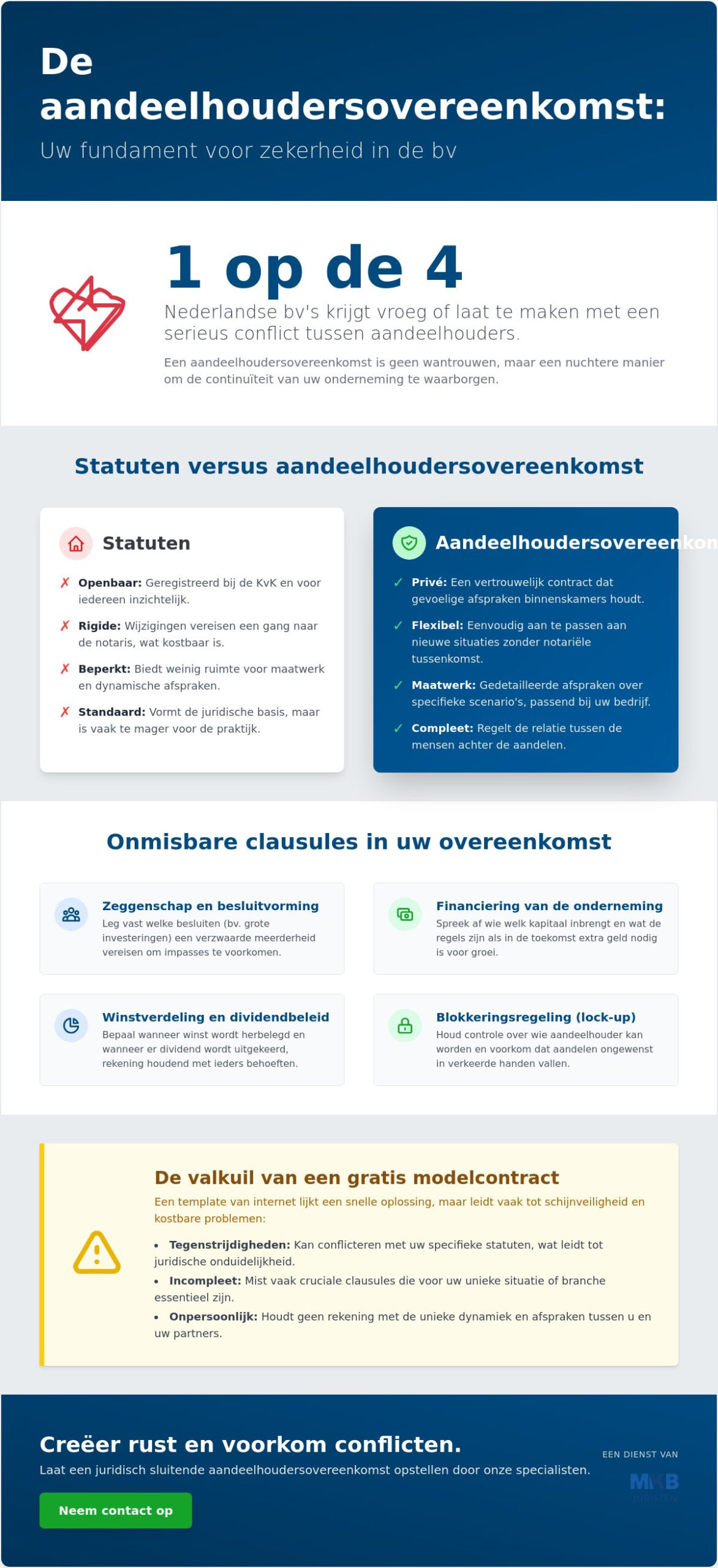
Did you know that one in four Dutch private limited companies will sooner or later face a serious shareholder conflict? It is a confronting statistic, especially when you are embarking on a new joint adventure with great enthusiasm. You likely recognize the feeling that everything is currently running harmoniously, but the fear of a future deadlock in decision-making or uncertainty regarding a partner's departure often remains present in the background. Drafting a shareholders' agreement is therefore not a sign of mistrust, but rather a pragmatic way to safeguard the continuity of your business.
In this guide, you will discover how to create peace of mind and prevent costly lawsuits with a legally sound document. We discuss the crucial agreements regarding profit distribution, control, and the impact of the new Wagevoe legislation that has been in effect since 2025. You will gain clarity on the relationship between your articles of association and additional agreements, so that you know exactly where you stand if a shareholder decides to leave. In this way, you build a foundation that not only protects your business interests but also maintains healthy human relationships within your company.
Key Points
- Understand why a private contract offers you more privacy and flexibility than standard articles of association at the Chamber of Commerce.
- Discover the essential clauses for drafting a shareholders' agreement, from day-to-day management to financing your growth.
- Avoid costly legal disputes by learning how to exclude inconsistencies between your articles of association and the agreement.
- Learn how to replace vague definitions of profit and control with crystal-clear agreements that provide peace of mind.
- Discover the benefits of a pragmatic approach that allows you to easily adjust your agreements without the intervention of a notary.
What is a shareholders' agreement and why are the articles of association not enough?
When starting a private limited company (BV), you cannot avoid visiting a notary for the articles of association. This document forms the legal backbone of your company, but in practice, this foundation often proves insufficient. Drafting a shareholders' agreement is essential because this document regulates the mutual relationships between the partners in a way that the articles of association simply cannot. While the articles of association primarily describe the structure of the company, the agreement focuses on the arrangements between the people behind the shares. For a deeper understanding of this concept, you can look at what a shareholders' agreement is in an international context. It is a private contract that gives you the freedom to make customized agreements regarding financing, dividend policy, and what should happen if a partner ceases to perform their duties.
A crucial difference lies in public access. The articles of association of your private limited company (BV) are filed with the Chamber of Commerce and are accessible to anyone. This means that competitors, suppliers, or curious third parties can see exactly how the formal rules within your company work. A Shareholders' Agreement (also known as a SHA), however, remains confidential. This provides you with the necessary privacy to record sensitive agreements regarding, for example, share valuation or specific non-compete clauses, without the outside world watching. It is the instrument par excellence for safeguarding the good relationship between partners; by having difficult conversations now, you prevent ambiguity from escalating into a conflict later.
The limitations of the articles of association of a private limited company
Articles of association are by nature formal and rigid. Do you want to make changes? Then you have to go back to the notary, which costs time and money. Moreover, articles of association offer little room for the dynamics of entrepreneurship. Agreements regarding who contributes which financing or how profits are distributed on top of standard dividend rules often do not fit within the standard framework of the articles of association. Furthermore, the law sets limits on what you may include in articles of association. A shareholders' agreement does offer that flexibility. You can develop detailed scenarios specific to your industry or growth phase, without being bound by the restrictive frameworks of formal corporate law.
Why a model contract from the internet is risky
It is tempting to pick a free template from the internet, but in the legal world, this is often a dangerous form of false security. A standard model fails to take your specific articles of association into account, which can lead to inconsistencies. If the articles of association state something different from your agreement, legal noise is created that becomes truly painful in the event of a conflict. Moreover, such models often lack clauses that are crucial for your specific sector. A poorly drafted contract is sometimes worse than no contract at all, because it creates the illusion of protection while you are in fact unprotected. Drafting a shareholders' agreement requires precision and insight into how your company truly operates.
Drafting the most important clauses for a shareholders' agreement
Once you and your partners have established the basic principles, it is time for the practical implementation. Drafting a shareholders' agreement is about creating rules that work in both good and bad times. One of the first matters to establish is day-to-day management and strategic decision-making. Which decisions may the board make independently, and for which matters is a reinforced majority of shareholders required? Consider major investments or taking out loans. The financing of the company also deserves a place; who contributes what capital, and what happens if additional funds are needed in the future? By discussing this in advance, you prevent your company's growth from stagnating due to a lack of resources or disagreement regarding the direction.
In addition, agreements regarding profit distribution and dividend policy are essential. Entrepreneurs often have different needs: one may wish to reinvest profits immediately, while another requires a stable payout. In the agreement, you can establish thresholds before dividends are distributed. The blocking clause is also an indispensable component. This allows you to maintain control over who joins as a shareholder. After all, you do not want one of your partners to simply sell their shares to a party with whom you do not click or who might even be a competitor.
Exit arrangements: drag-along and tag-along rights
What happens if an external party makes an offer for the entire company? With a drag-along clause, a majority of shareholders can force the minority to sell their shares under the same conditions. This is crucial for the saleability of your private limited company. On the other hand, the tag-along right offers protection to minority shareholders; they are granted the right to piggyback on a sale by the majority. A clear valuation method for the shares forms the basis here to prevent disputes over the price.
Bad leaver and good leaver provisions
A partner's departure can have various causes. A 'good leaver', for example due to retirement or long-term illness, usually receives the full market value for their shares. The situation is different for a 'bad leaver', such as in the case of misconduct or dismissal for urgent reasons. Substantial discounts on the share price often apply in such cases, sometimes ranging from 50% to as much as 80%. Please note: since April 2026, the Tax and Customs Administration has adopted a specific position regarding the tax implications of bad leaver clauses, whereby price differences are sometimes taxed in a complex manner in Box 1 and Box 2. It is therefore advisable to always consult the most current tax frameworks when drafting a shareholders' agreement
Non-compete and non-solicitation clauses
You want to prevent a departing partner from immediately running off with your client list or sharing sensitive business information. A robust non-compete and non-solicitation clause protects your intellectual property and the market position of your BV. By attaching a penalty clause to this, you create an effective deterrent. This ensures peace of mind and security within the company, as everyone knows that the accumulated value remains within the company walls.
Privacy and flexibility: the strategic benefits of the agreement
Did you know that your competitors can view your articles of association at the Chamber of Commerce with just one simple click of a button? For many entrepreneurs, that is an unpleasant thought. Drafting a shareholders' agreement offers you the much-needed discretion that is lacking in the articles of association. Because the agreement is a private contract, it does not need to be registered with the Chamber of Commerce. This means that sensitive agreements regarding profit targets, specific sales restrictions, or the exact valuation of the company remain completely confidential. It is your internal blueprint that gives you control without the outside world looking over your shoulder.
In addition to privacy, flexibility is a huge asset. While an amendment to the articles of association must always go through a notary, you can adjust a shareholders' agreement mutually. This not only saves on notary fees but also ensures that you can adapt quickly if the situation within your company changes. Moreover, this document allows you to deviate from standard rules. Do you want to grant a partner greater profit rights because they contribute capital, but distribute control equally? With a smart agreement, you can easily record these kinds of customized arrangements. This also offers protection against external influences, such as heirs who might suddenly want a say in the direction of your company after a death.
Confidentiality within the business market
In the business world, information is power. You do not want agreements regarding the strategy for the next five years or the terms under which an investor joined to be recorded in a public register. Especially during investment rounds, privacy is crucial to protect your negotiating position. Additionally, the agreement helps with your GDPR compliance. The shareholders' register contains personal data that you prefer not to share more widely than strictly necessary. By keeping the details of the partnership within the SHA, you limit the amount of privacy-sensitive information in your public documents.
Custom solutions for different types of shareholders
Not every shareholder has the same role. You often deal with active partners who are on the shop floor every day and silent partners who only provide capital. Drafting a shareholders' agreement enables you to establish specific rules for each type of partner. For business angels, for example, you can include specific information or veto rights that do not apply to the founders. We often link these agreements directly to management agreements for the directors. This creates a watertight framework in which everyone's roles, remuneration, and responsibilities are crystal clear, regardless of their shareholding percentage.
Common mistakes and pitfalls when drafting
At first glance , drafting a shareholders' agreement seems like a matter of putting straightforward agreements on paper. However, in practice, things often go wrong over details that only become painful when relationships are under pressure. One of the most common mistakes is the use of unclear financial definitions. When do you speak of 'profit'? Is that the net profit, or do you mean EBITDA? Without clear definitions, a discussion regarding dividend payments or share valuation can quickly turn into a legal tug-of-war. Additionally, we often see entrepreneurs forget to include a precedence clause. If the articles of association state something different from your agreement, there must be a clear rule determining which document takes precedence. Usually, you stipulate that the agreement between shareholders takes precedence over the articles of association.
Another underestimated factor is the role of the spouse or partner. If you are married in community of property, your shares fall within the marital community. In the event of a divorce, your ex-partner may suddenly claim the value of the shares, which can directly impact your company's liquidity. It is therefore essential to stipulate, when drafting a shareholders' agreement , that shareholders must possess appropriate prenuptial agreements. This prevents personal issues from unintentionally jeopardizing the stability of your BV.
The deadlock situation: when the votes are tied
Nothing is as frustrating as a business grinding to a halt because of a tie vote. With a 50/50 split between two partners, this risk is very real. Without an effective dispute resolution mechanism, you end up in a deadlock where no strategic decisions can be made. Creative solutions such as the 'Russian roulette' clause (where one partner offers a price and the other must buy or sell) or the 'Texas shoot-out' can break this cycle. Engaging an independent expert for a binding opinion is also a practical way to resolve an impasse without the need for an expensive trip to court.
Differences in interpretation and the role of Haviltex
In Dutch law, not only is the literal text of a contract important, but also what the parties could reasonably expect from one another. This is known as the Haviltex criterion. To prevent disputes afterwards, a strong preamble is indispensable. In this introduction, you describe the background and the joint intention of the collaboration. It provides a judge with a framework for interpreting the agreements should ambiguity arise later. Do you want to be certain that your agreements are watertight and leave no room for interpretation? Then have your documents checked via our ContractCheck™ for immediate legal certainty.
Drafting a shareholders' agreement with MKB Juristen
MKB Juristen believes that legal matters do not have to be unnecessarily complicated. Our pragmatic approach ensures that you get exactly what you need: a document that works in practice and brings peace of mind within your organization. Drafting a shareholders' agreement is often part of a larger legal foundation. That is why we seamlessly integrate this document into our legal starter package for businesses. This allows you to lay a solid foundation for your entire business operation in one go, from general terms and conditions to internal agreements between partners. This prevents you from having to have separate contracts drawn up later that might not align well with one another.
Have you already put a draft on paper yourself or used a template from the internet as a basis? Then it is wise not to take any risks regarding the continuity of your BV. Use our ContractCheck™ to have your text checked by an experienced legal expert. We take a close look at any inconsistencies with your articles of association and tax pitfalls that you might overlook yourself. With us, you always know where you stand thanks to our transparent working method. We work with clear agreements so that you are never faced with surprises afterwards regarding costs or turnaround time.
Tailor-made solutions for every stage of your business
Whether you are just starting out with multiple partners or are an experienced entrepreneur welcoming a new investor, we offer support tailored to your specific stage. Guidance during the start-up of a private limited company requires a different focus than adjusting agreements when a business angel comes on board. We also stand by your side as an expert partner when renegotiating existing contracts. We ensure that the new agreements optimally protect your business interests without compromising the human element or the working relationship with your fellow shareholders.
Get started with your business contracts immediately
Our process is methodical and efficient. After a brief intake, we immediately translate your wishes into a legally sound document. No dusty jargon or endless tangents, but clear language that aligns with the daily practice of your business. Entrepreneurs choose the down-to-earth approach of MKB Juristen because we understand that legal certainty is a means to grow worry-free. We take the weight of the matter off your hands so that you can focus on what really matters: your business. Contact us for a tailored shareholders' agreement and arrange your business security today.
Build a future-proof partnership
You are now aware of the strategic value that a private contract offers in addition to standard articles of association. By making clear agreements regarding profit, control, and exit scenarios, you lay a solid foundation for your company. Drafting a shareholders' agreement is not a vote of no confidence; on the contrary, it is a professional step to protect your business relationships and capital against unforeseen impasses. This way, you remain in control, regardless of the course your company takes in the future.
At MKB Juristen, we specialize in the specific challenges faced by SME entrepreneurs. We employ a transparent working method with no hidden costs, so you always know where you stand. Do you already have a draft? With our ContractCheck™, we offer you maximum assurance that your document is legally sound and aligns perfectly with your current articles of association. Have your shareholders' agreement drafted by MKB Juristen and choose a down-to-earth, pragmatic approach. We are happy to help you continue doing business with peace of mind.
Frequently asked questions about the shareholders' agreement
Is a shareholders' agreement mandatory for a private limited company?
No, a shareholders' agreement is not legally required for a private limited company (BV). While the articles of association are mandatory upon incorporation, this contract is a voluntary addition. Nevertheless, it is indispensable for virtually every company with multiple shareholders to prevent impasses. Without this document, you fall back on general legislation, which often does not align with your specific business needs and the dynamics of your partnership.
What is the difference between articles of association and a shareholders' agreement?
The main difference lies in the public nature and flexibility of the documents. Articles of association are formal, publicly registered with the Chamber of Commerce, and require a notary for every amendment. A shareholders' agreement is a private document that is not public. This allows you to make confidential agreements regarding matters such as profit distribution and exit scenarios that you would prefer not to share with competitors, suppliers, or the rest of the market.
What does it cost to draft a shareholders' agreement on average?
The costs for having this document drafted typically range between €1,000 and €3,000 in the market. This amount depends on the complexity of the agreements and the number of parties involved. Although this is an investment, the costs do not outweigh the tens of thousands of euros that legal proceedings in a shareholder dispute can cost. It is a necessary insurance for your business stability.
Can I draft a shareholders' agreement myself using a template?
Technically, you can draft a shareholders' agreement yourself using a template from the internet, but this entails significant risks. Standard templates do not take into account your specific articles of association or industry. Inconsistencies between documents can lead to legal uncertainty. A professional check is always advisable to guarantee that the clauses will actually hold up in court should a disagreement unexpectedly arise.
What happens if there is no shareholders' agreement in the event of a conflict?
In the event of a conflict without an agreement, you fall back on the statutory dispute resolution procedure and the articles of association. Since the introduction of the Wagevoe Act in 2025, this often proceeds via the Enterprise Chamber in Amsterdam. These are often time-consuming and expensive procedures that completely paralyze daily business operations. Drafting a shareholders' agreement prevents this misery by establishing clear rules in advance regarding withdrawal, valuation, and decision-making within your private limited company.
Does a shareholders' agreement need to be notarized?
No, you do not need to go to a notary for a shareholders' agreement. It is a private deed that is legally valid as soon as all shareholders have signed it. This also makes the document much more flexible than the articles of association. This saves you notary fees and allows you to implement changes more quickly when the collaboration or the direction of the company requires it. Only the amendment to the articles of association itself requires a notarial deed.
How long is a shareholders' agreement valid?
In principle, a shareholders' agreement remains valid as long as the private limited company (BV) exists and the parties involved are shareholders. The agreements usually expire automatically for a shareholder who sells all their shares and leaves the company. However, certain clauses, such as the non-compete clause or the duty of confidentiality, often remain in force for an agreed period of one to two years after departure to protect the interests of the company.
Can we amend a shareholders' agreement retroactively?
Yes, you can amend the agreements at any time, provided all shareholders agree. This is a major advantage compared to rigid articles of association. Because the market and your company are constantly changing, it is wise to review the agreement periodically. You simply record any changes in an addendum signed by all parties, ensuring your legal basis always remains up to date.




