

MKB Juristen drafts custom legal documents
It is best not to cobble together or copy important contracts, terms and conditions, and other legal documents yourself. We help entrepreneurs on a budget with customized legal solutions, clear costs upfront, and practical explanations.
- Custom contracts, terms and conditions, and legal documents
- Budget-friendly and clear about the costs upfront
- Request a free consultation or a no-obligation quote
What if your most promising business partnership turns into a costly legal minefield tomorrow? Many entrepreneurs start a new project with a handshake and a healthy dose of enthusiasm, but forget that business reality in 2026 can be unpredictable. Drafting a professional partnership agreement is therefore not a sign of mistrust; it is the blueprint for a successful relationship in which risks are eliminated in advance.
You likely want to focus on growth and innovation, not on sleepless nights due to uncertainty regarding intellectual property or concerns about liability for your partner's mistakes. It is perfectly understandable that the legal side of running a business can sometimes feel overwhelming. In this practical guide, you will discover exactly how to create a watertight document that protects your interests and effectively prevents legal conflicts. We walk you through the essential components, from clear agreements on profit distribution to concrete exit scenarios and the impact of the tightened DBA Act. This way, you build a foundation that offers peace of mind and predictability for your business.
Key Points
- Understand why a written contract is the foundation of every business relationship and why verbal agreements will no longer suffice for growing businesses in 2026.
- Learn which essential elements, such as the specific contributions of partners and profit distribution, absolutely must not be missing from your document.
- Discover the risks of a do-it-yourself approach and how drafting a professional collaboration agreement prevents legal gaps and unclear wording.
- Identify common pitfalls, such as the lack of a deadlock clause, to effectively avert future decision-making impasses.
- Gain insight into how a pragmatic legal partner completely unburdens you, from the initial consultation to a final and legally signed contract.
What is a cooperation agreement and why is it essential for SMEs?
A collaboration agreement is much more than a stack of paper; it is the legal foundation upon which you build your business future. At its core, it is a document in which two or more entrepreneurs set out how they will work together on a project or business objective. Without this foundation, you are building on shifting sands. In the euphoria of a new start, everything often seems clear, but with growth or unexpected setbacks, memories of those initial conversations fade quickly. In today's business world, verbal agreements are simply insufficient to protect your interests.
In 2026, the business environment is more complex than ever. With the active enforcement of the DBA Act and stricter rules regarding liability, a written contract provides the necessary evidence. It prevents you from ending up in a costly and protracted lawsuit when partners' visions diverge. Moreover, a well-structured document significantly lowers the barrier to financing. Banks and investors demand transparency; they want to see that risks are professionally covered before providing capital. For a broader perspective on the legal status of formal agreements in the Netherlands, you can look at how such agreements are valued in practice.
The difference between a partnership and a company
Many entrepreneurs hesitate between establishing a general partnership (VOF) or working with a separate agreement. With a VOF, you are personally jointly and severally liable for all the partnership's debts, which can be a significant risk. A separate partnership agreement often offers more flexibility without that far-reaching liability. You retain your own entity while still joining forces. The choice depends on your long-term goals and the desired tax structure. An agreement is ideal for temporary projects or when you want to keep the risks strictly separate from your other business activities.
Why a standard model contract is often risky
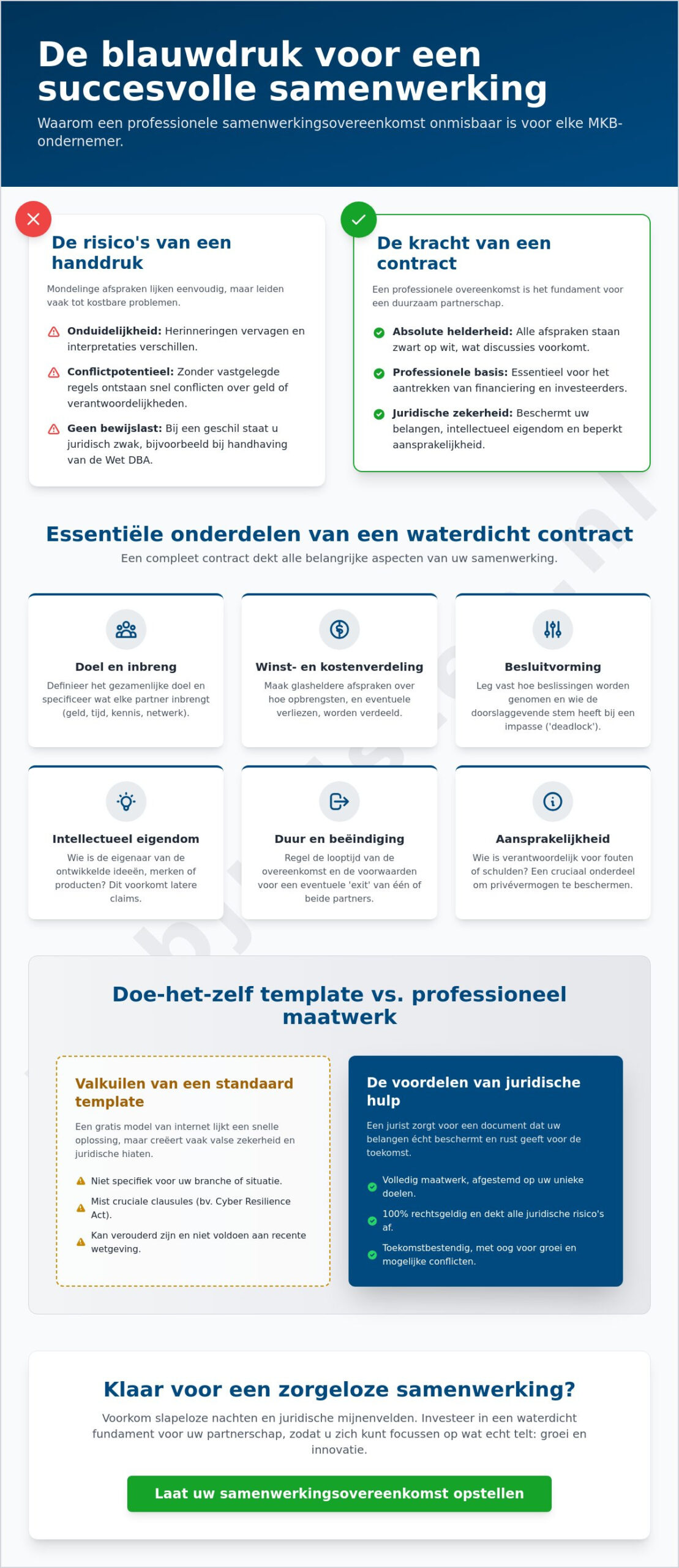
It is tempting to quickly grab a template from the internet, but in practice, this often leads to trouble. General templates do not take into account the unique dynamic between you and your partner or the specific requirements of your industry. Consider, for example, the Cyber Resilience Act, which imposes stricter requirements on digital products in 2026; a standard template rarely covers this. Drafting a collaboration agreement through an expert partner ensures the necessary customization. Missing clauses regarding intellectual property or an exit strategy can lead to unintended legal gaps that leave your company vulnerable to claims or loss of property.
The key components of a watertight cooperation agreement
Drafting a collaboration agreement starts at the absolute core: what is the shared goal? Without a sharply defined long-term vision, noise will inevitably arise sooner or later. Therefore, clearly define exactly what both parties wish to achieve and the resources they will deploy to do so. This goes beyond just a financial investment. Consider the contribution of specific knowledge, man-hours, networks, or business assets. By quantifying this contribution in advance, you prevent resentment when the workload increases.
The distribution of revenues and costs is often the biggest source of conflict. Make crystal-clear agreements regarding this. How are profits distributed, and who bears any potential losses? Decision-making is at least as important. Who has the deciding vote in the event of a deadlock? A good "deadlock" clause prevents your company from becoming paralyzed in the event of a disagreement. If you opt for a very close integration, it is wise to use the agreements recorded in a joint venture as a frame of reference as well
Remember that this contract is closely linked to your general terms and conditions. While the terms and conditions define the general rules for all your clients, the cooperation agreement regulates the specific dynamic between you and your partner. It is essential that these two documents do not contradict each other. Do you want to be sure that your foundation is solid? You can always have your current documents reviewed via an expert contract check.
Liability and insurance
In a good agreement, you precisely define who is responsible for what. This protects your private assets against errors made by your partner. Always align these clauses with your professional liability insurance. This ensures that the terms of your contract are actually covered by your policy in the event of potential third-party claims.
Confidentiality and non-compete clause
Your intellectual property and trade secrets are your company's capital. Protect them with a strong non-disclosure agreement (NDA). Additionally, a reasonable non-compete clause ensures that a partner does not immediately run off with your joint knowledge to the competition. Always attach specific penalty clauses to this to make the agreements enforceable in court.
Drafting a collaboration agreement yourself versus legal assistance
It is a tempting thought: you find a free template online, fill in the names, and you are ready to go. Drafting a collaboration agreement yourself does indeed save you time and money in the short term. For simple, short-term projects with a low risk profile, this can work perfectly well. However, the reality is that a downloaded template rarely takes into account the specific risks of your industry or the unique agreements you made during lunch. A contract is only truly valuable when it facilitates the difficult conversations that you would rather postpone yourself.
The greatest risks of do-it-yourself contracts lie in legal loopholes and vague wording. Terms such as “to the best of one’s ability” or “by mutual agreement” may seem appealing, but they offer no guidance whatsoever when tempers flare. A legal expert is indispensable whenever joint intellectual property is involved, significant investments are made, or when working with sensitive customer data. The cost of a professionally drafted document pales in comparison to the financial and emotional damage of a protracted lawsuit. A proper cost-benefit analysis demonstrates that you are investing in the continuity of your business; it serves as insurance against future impasses.
The ContractCheck™: a middle ground for entrepreneurs
Have you already started writing but are unsure about its legal validity? The ContractCheck™ from MKB Juristen offers the ideal middle ground. You submit your own draft, and an experienced legal expert validates the content for critical risks. We look not only at what is written, but especially at what is missing. You receive immediate feedback on unreasonable clauses, and we add the necessary safeguards to optimally protect your interests in 2026. This minimizes your risks without having to outsource the entire process.
Customization versus standardization in 2026
In a market that is digitizing at lightning speed, static contracts no longer suffice. Modern enterprises require flexibility that still offers security. By combining your partnership agreement with tailored general terms and conditions, you create a legal shield. The agreement governs the relationship with your partner, while the terms and conditions cover external risks. When these documents align seamlessly and legally reinforce each other, you can do business with peace of mind. It is not about filling pages, but about creating a workable and understandable framework for success.
Avoiding pitfalls and risks in business collaborations
Collaboration is like a marriage; you hope for the best, but you must be financially and legally prepared for the worst. Drafting a collaboration agreement is only truly successful if you also describe the scenarios you would rather not think about. One of the biggest pitfalls is ambiguity regarding the duration of the collaboration. Is the contract for an indefinite period, or are you linking it to a specific project? Without clear notice periods, you could unintentionally find yourself stuck with a partner who stops delivering, or suddenly be confronted with a departing partner at a crucial moment.
Furthermore, the absence of a deadlock clause is a recipe for business paralysis. When votes are tied on an important decision, who makes the final decision? Without prior agreements, such a situation often ends up in court, which costs not only money but also damages the relationship. Also, do not forget that your business grows and changes. Make agreements on how you can amend the agreement in the future and stipulate that all changes must be confirmed in writing. Would you like to know more about structurally protecting your business? Then see how you can limit your company's legal risks through proper file building.
The exit strategy: what if the collaboration ends?
A well-thought-out exit strategy is the safety belt of your partnership. You must determine what happens in the event of voluntary withdrawal, but also in the case of a forced departure due to, for example, illness, bankruptcy, or misconduct. How do you value the jointly accumulated assets at that moment? Do you use a fixed formula based on profit figures, or do you engage an independent expert? Agreements regarding the retention of clients and relationships after the split also prevent a business separation from escalating into a legal trench war. Ensure that you stipulate whether a departing partner may retain their own clients or whether they remain with the partnership.
Negotiation tips for an equal relationship
Discussing difficult topics can sometimes feel uncomfortable, but it is essential for a healthy and equal relationship. Be transparent about your own expectations and goals from day one. This builds trust rather than suspicion. A golden rule: never sign under time pressure. A partner who forces you to sign immediately without room for a legal review is often not the partner you are looking for. Take the time to have everything calmly assessed by an expert who stands by your side and understands your interests.
Do you want to be sure you don't overlook any pitfalls in your partnership? Have your contract professionally reviewed by a lawyer familiar with SME practices. Request a ContractCheck™ here for maximum certainty.
Have your cooperation agreement drafted by MKB Juristen
Drafting a collaboration agreement does not have to be a cumbersome process full of incomprehensible jargon. At MKB Juristen, we believe in a pragmatic approach where legal depth goes hand in hand with down-to-earthness. We understand that as an entrepreneur, you need clarity and speed, not lengthy documents that end up gathering dust in a drawer. Our legal experts stand by your side as partners and translate your commercial agreements into a solid legal framework that creates peace of mind and predictability for your business.
The process is simple and transparent. It begins with a thorough intake where we discuss your specific situation and goals. Based on this, we get to work on the draft. You won't receive a standard fill-in-the-blanks exercise, but a custom solution that takes the risks of 2026 into account. After your feedback, we refine the text until we have a final, signed contract that both parties fully support. This methodical approach ensures that you know exactly where you stand, from the initial meeting to the final signature.
Many SME entrepreneurs choose our expertise because we speak the language of the market. We know what it is like to seize opportunities while simultaneously wanting to arrange your support. Furthermore, for those just starting out or making a fresh start, we offer a legal business starter package . This package lays a broad foundation for your company, ensuring that not only your partnerships but your entire legal affairs are in order.
Direct support with your business contracts
In addition to partnerships with other entrepreneurs, you often deal with external assignments. We can also fully unburden you when drafting service agreements . Our experienced legal experts safeguard your interests in every agreement you make. We maintain transparent rates and provide you with a clear delivery time estimate in advance. No surprises afterwards; just honest legal advice that strengthens your business operations and minimizes risks.
Ready for a safe start?
Do you want to prevent unclear agreements from leading to costly conflicts later on? Lay the foundation for a successful and worry-free collaboration today. A good contract is the best investment in your business relationship. Contact us for a no-obligation initial assessment of your situation and discover how we can help you draft a professional collaboration agreement.
Contact MKB Juristen for your cooperation agreement
Building a future-proof partnership in 2026
A successful business relationship begins with eliminating uncertainty. We have seen that a well-thought-out exit strategy and clear agreements regarding intellectual property are essential to protect your business. In the dynamic market of 2026, drafting a professional collaboration agreement is not a luxury; it is the foundation for stability and growth. By addressing risks such as liability and decision-making in advance, you prevent a disagreement from escalating into a costly conflict.
MKB Juristen has specialized in SME law since 2009 and understands the challenges you face every day. Whether you choose a completely new contract or our ContractCheck™ for maximum security, we offer transparent and business-like rates with no hidden costs. Do you want to do business with peace of mind and legally anchor your partnership? Have your cooperation agreement professionally drafted by MKB Juristen. Together, we lay a solid foundation for your business success.
Frequently asked questions about cooperation agreements
Is a cooperation agreement mandatory for a business partnership?
No, it is not legally required to have a written contract, but it is essential for your legal certainty. Without documentation, in the event of conflicts, you fall back on general legislation, which often offers insufficient protection for the specific needs of your business. Drafting a cooperation agreement ensures that you have the burden of proof and define risks regarding liability and profit sharing in advance.
What is the difference between a cooperation agreement and a partnership agreement?
A partnership agreement is intended for entrepreneurs forming a new legal entity together, such as a general partnership (VOF). In this case, you are often personally jointly and severally liable for the debts of the VOF. A collaboration agreement is more flexible and regulates the arrangements between two independent parties who retain their own identity and limited liability while working on a joint project.
Can I amend a collaboration agreement midway through its term?
Yes, you can always amend an agreement provided both parties consent. It is advisable to include a clause in the original contract stating that changes are only valid in writing and signed. This prevents ambiguity regarding verbal commitments made later in the collaboration and keeps your legal foundation up to date.
What happens if my partner does not comply with the agreements in the contract?
When a partner violates the agreements, this constitutes a breach of contract. You can then formally put the partner in default and demand performance or compensation. A well-drafted contract includes a dispute resolution clause that precisely describes the steps you must take—such as mediation or going to court—to resolve the situation without immediately jeopardizing your entire business operations.
What about intellectual property rights in a collaboration?
The general rule is that the creator of a work owns the copyright, unless you stipulate otherwise. In a business partnership, it is crucial to explicitly determine who becomes the owner of jointly developed products, software, or concepts. Drafting a collaboration agreement without clear clauses regarding intellectual property can lead to major problems when a partner leaves and claims the rights to your joint innovation.
Do I need to register a collaboration agreement with the Chamber of Commerce?
No, you do not need to register a standalone partnership agreement with the Chamber of Commerce. It is a private law agreement between the parties. Only when you decide to establish a new legal form, such as a general partnership (VOF) or a private limited company (BV), are you required to register the articles of association or the partnership agreement in the Trade Register. In most cases, your mutual agreements remain confidential between you and your partner.
What are the costs for having a cooperation agreement drawn up?
The costs depend entirely on the complexity of your collaboration and the specific risks you wish to cover. Tailored legal advice from a lawyer is an investment that pays off by preventing costly lawsuits and business impasses. We always recommend opting for a fixed price agreement so that you know exactly where you stand in advance and avoid any surprises.
How long is a cooperation agreement typically valid?
You determine the validity period yourself in the agreement. You can opt for a fixed term, for example for the duration of a specific project, or for an indefinite contract with a clear notice period. It is advisable to schedule periodic evaluation moments so that you can assess whether the agreements made still align with the growth and direction of your company.




