

MKB Juristen drafts custom legal documents
It is best not to cobble together or copy important contracts, terms and conditions, and other legal documents yourself. We help entrepreneurs on a budget with customized legal solutions, clear costs upfront, and practical explanations.
- Custom contracts, terms and conditions, and legal documents
- Budget-friendly and clear about the costs upfront
- Request a free consultation or a no-obligation quote
Did you know that a simple termination letter is more often the start of a protracted legal battle than a clean break? Many entrepreneurs send a standard text without truly understanding the fine print, only to be confronted with hefty damage claims or unexpected notice periods that continue for months. In 2026, seeking professional legal advice on contract termination is no longer a luxury, especially now that the rules surrounding long-term agreements and the interpretation of unforeseen circumstances are being scrutinized increasingly strictly by Dutch courts.
You probably just want to end a stifling partnership without the other party having a legal leg to stand on. It is perfectly understandable that you do not have time to spend hours deciphering complex legal texts or that you are worried about the financial consequences of an incorrect termination. In this practical guide, you will discover how to safely terminate business contracts and minimize the risks of damage claims. We offer you clear confirmation of your legal position and a step-by-step plan to execute the termination immediately, so that you can continue doing business with certainty and peace of mind.
Key Points
- Learn why the Van Dam Act does not apply to business agreements and how this affects your notice period.
- Understand the legal difference between termination and dissolution to avoid unnecessary damages to the opposing party.
- Discover how to identify hidden penalty clauses and unfavorable terms in the fine print of your contractual partners.
- Receive practical legal advice on contract termination to strengthen your business position and ensure a watertight termination.
- Follow a clear step-by-step plan to safely terminate long-term agreements for an indefinite period in accordance with the latest legislation of 2026.
Legal advice on terminating a contract: why the business market works differently
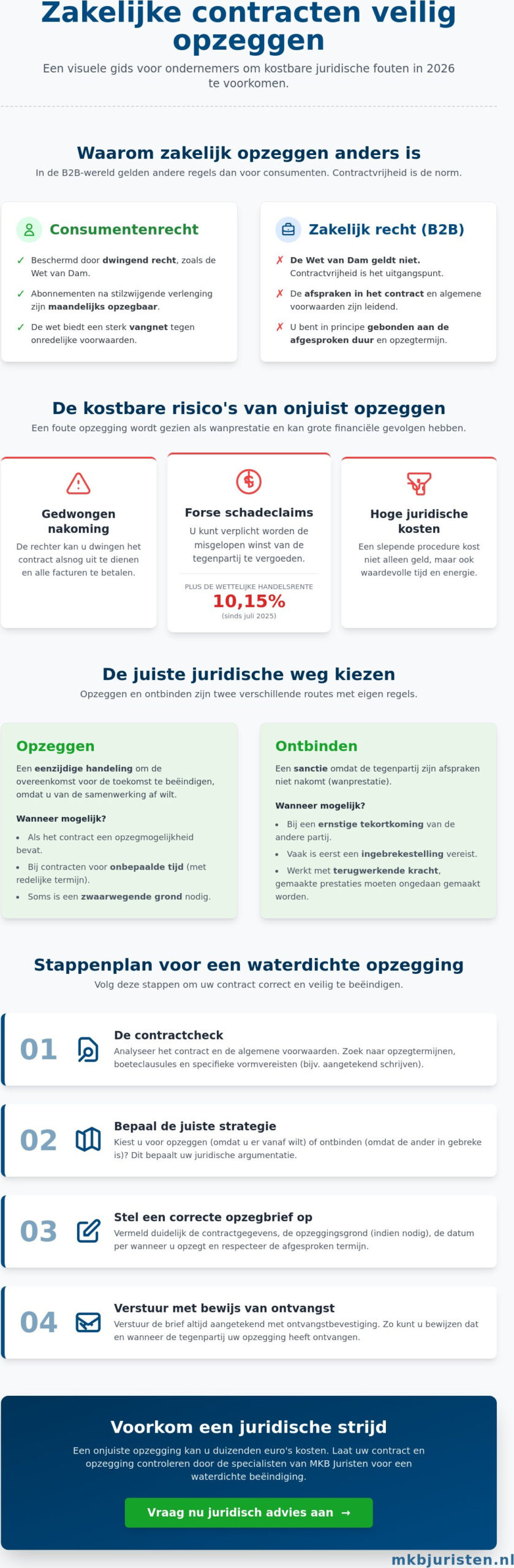
The law makes a sharp distinction between a consumer cancelling a magazine subscription and an entrepreneur terminating a supplier contract. While consumers are protected by a safety net of mandatory law, freedom of contract reigns in the business world. This principle implies that you and your trading partner largely determine the conditions under which you terminate the collaboration. In the B2B sector, the legal foundations of a contract assume that both parties are professional enough to look out for their own interests. That sounds fair, but it also means that you often cannot rely on general protection rules if things go wrong.
Many entrepreneurs mistakenly believe that the Van Dam Act offers them an escape route. This law ensures that consumer subscriptions can be cancelled on a monthly basis after tacit renewal. However, this does not apply to your business. If you have signed a three-year contract without the option to cancel early, you are, in principle, bound by it. Precisely because the law leaves little room for interpretation here, legal advice regarding the specific termination of a contract is crucial before you send a registered letter. An incorrect assumption about your cancellation rights can lead to a legal conflict that you could have prevented.
The myth of the statutory notice period for companies
There is no general statutory notice period for business agreements. The period you must observe is almost always stated in the contract itself or in the accompanying general terms and conditions. Sometimes there is a “reflex effect,” whereby a very small business or self-employed professional in a consumer-like position enjoys some protection. However, this is an exception, not the rule. In 2026, we expect judges to increasingly consider reasonableness and fairness regarding long-term contracts for an indefinite period where no notice period has been agreed. Nevertheless, the main rule remains simple: the written agreements take precedence. Do you not have these readily available? Then a ContractCheck™ you quickly map out your actual position.
Risks of unlawful termination
Are you terminating the collaboration without following the proper notice period or procedure? Then you are in breach of contract. The counterparty can then demand performance through the courts, which means you will be forced to purchase and pay for the services. In addition, you run the risk of damage claims. Since July 2025, the statutory commercial interest rate for late payments in commercial transactions is 10.15%. In the event of an unlawful termination, these costs, together with your partner's lost profits, can put significant pressure on your cash flow. Seeking sound legal advice beforehand regarding contract termination not only saves you this financial headache but also ensures that you can shift your focus to new growth opportunities with peace of mind.
The legal grounds: cancelling, dissolving, or terminating
Do you understand the difference between termination and dissolution? It seems like a semantic matter, but legally speaking, there is a world of difference. When seeking legal advice on terminating a contract, this is often the first point we clarify. Termination is a unilateral act in which you end the agreement for the future. You simply stop the collaboration because you want to. Dissolution, on the other hand, is a sanction. You draw a line through the contract because the other party has made a serious mistake.
What if your contract contains no provision at all regarding how you will separate? In practice, this occurs more often than you might think. Although long-term agreements for an indefinite period are fundamentally always terminable, you cannot simply pull the plug. Reasonableness and fairness play a crucial role here. In a collaboration that has been ongoing for years, a judge will usually not accept that you stop from one day to the next. In such cases, you need a compelling reason or must offer a generous transition period. This gives the other party the opportunity to prepare for the loss of revenue or services.
Terminating a fixed-term contract
Have you signed a contract for a fixed period, such as two years? In that case, early termination is usually not possible, unless this is explicitly stated in the text. Without such a clause, you are bound by the agreement until the end date. In 2026, pay extra attention to clauses regarding automatic renewal. In the business market, a contract is often tacitly converted into an agreement for an indefinite period or renewed for a fixed period after the end date. Do you want to prevent this? Then ensure that you confirm the termination in writing well before the deadline.
Dissolution due to breach of contract
If a supplier systematically fails to meet their obligations, you do not have to passively wait until the contract term has expired. You can then opt for termination due to non-performance. However, this requires a careful approach. In most cases, you must first give the other party a final chance via a written notice of default. Only if the other party still fails to perform within the set period can the contract be officially terminated. For a deeper dive into this process, you can consult our guide on business advice regarding breach of contract . Are you unsure whether the failure is serious enough? Then seek legal support to avoid being the one acting unlawfully.
The contract check: mapping out your rights and obligations
When considering terminating a business relationship, a look at the main contract is only half the job. The real risks often lie in your contract partner's attached general terms and conditions. Legal advice on professional contract termination therefore always begins with a comprehensive analysis of all agreements you have ever entered into. Did you critically examine the fine print at the time, or did you sign simply to get started quickly? In the daily practice of entrepreneurship, these documents often disappear into a folder unread, but upon termination, they determine your legal standing.
Many entrepreneurs are surprised by hidden penalty clauses or unexpected notice periods tucked away deep within the terms and conditions. Exclusivity clauses can also severely restrict your freedom of movement after termination. Such a clause may prohibit you from purchasing services from a direct competitor for a certain period, which can paralyze your business operations after your departure. Identifying these pitfalls is essential to prevent a desired separation from escalating into a costly legal conflict. To recognize these types of risks in a timely manner, it is wise to systematically review business contracts using a practical checklist before proceeding with termination.
Critical points in your agreement
Before sending the cancellation letter, you must be certain regarding the formal requirements. An error in the addressing or the sending method can invalidate your cancellation. Therefore, pay close attention to the following points:
- The termination method: Is it explicitly stated that termination must be done by registered letter? Although digital communication will be the standard in 2026, specific contractual agreements always take precedence.
- Vague terms: Terms such as 'a reasonable notice period' often lead to discussion. In business practice, how this is interpreted depends on the duration of the collaboration and the investments made by both parties.
- Proof: Ensure that you can always demonstrate that the cancellation actually reached the other party. Carefully retain proof of dispatch and digital confirmations of receipt.
Use the ContractCheck™
Even for the most experienced entrepreneur, legal jargon is sometimes difficult to decipher. A subtle nuance in a sentence can have major financial consequences for your cash flow. With our ContractCheck™ , you receive a clear risk analysis of your current contracts. We scan your documents for unfavorable clauses and advise you on the safest route to termination. This gives you the peace of mind and certainty that the counterparty will have no grounds to stand on afterwards. Avoid unknowingly agreeing to unfavorable terms and have your position assessed in advance by an expert in legal advice regarding contract termination.
Step-by-step plan for a watertight termination of your business contract
You have decided to terminate the collaboration. Now it comes down to precise execution. In the business world of 2026, an informal email or a phone call is rarely sufficient to terminate a legally binding agreement. To avoid being unintentionally stuck with an automatic renewal or risking a claim for damages, follow this step-by-step plan for a safe settlement.
- Analyze the termination clause: Retrieve the contract and the general terms and conditions. Specifically look for the required notice period and the method for giving notice.
- Determine the dates: Calculation is essential. If you have a three-month notice period and the contract expires on December 31, your letter must be received by the other party no later than September 30.
- Draft the formal letter: Use a business tone. Clearly state your company details, the contract number, and the intended end date.
- Send the cancellation by registered mail: This is your most important piece of evidence. In 2026, digital registered mail is more widely accepted, but check if your contract allows this.
- Confirm and finalize: Request a written confirmation of receipt. Additionally, check if there are any outstanding invoices or loaned items that need to be settled.
When proceeding with these steps, seeking legal advice on cancelling the contract is the best way to ensure you do not make any formal errors. After all, a minor mistake in calculating the term can result in you being unintentionally stuck with an expensive subscription for another entire year.
The content of a good resignation letter
Keep your termination letter brief and factual. You do not need to provide extensive reasons for stopping, unless the contract specifically requires it. In fact, citing reasons can sometimes work against you if the other party uses those arguments to challenge the termination. Stick to the essentials: stating that you are terminating the agreement as of the earliest possible opportunity. Make a clear distinction between a polite notice of termination and the actual legal termination; only the latter counts towards the deadline.
Burden of proof and communication
The burden of proof that a notice of termination arrived on time rests entirely with you. An email sent in your 'sent' box is legally shaky if the other party claims never to have received it. Therefore, always use registered mail or a digital sending method with delivery and read confirmation. Is the other party ignoring your letter? Do not wait. Keep the complete file, including proof of postage and copies of all correspondence. Should a dispute arise later regarding the end date, you will be in a very strong position with this file. Are you unsure about your partner's response? Our experts offer the necessary legal support to de-escalate the situation immediately.
How MKB Juristen helps entrepreneurs with complex terminations
Entrepreneurship is about looking ahead, but sometimes the most important step is actually closing a chapter that no longer aligns with your ambitions. At MKB Juristen, we understand that you have no need for ivory-tower advice or thick files full of legal jargon. You are looking for a partner who stands by your side and understands how business reality works in 2026. Our legal advice on terminating contracts is therefore always based on a down-to-earth, pragmatic approach. We look not only at what the law says, but above all at the shortest and safest route to achieve your goal.
Whether it concerns a one-off supplier agreement or a strategic partnership spanning years, every situation requires its own strategy. Sometimes a sharp, formal letter suffices to remind the other party of the agreements made. In other cases, subtle negotiation regarding early termination is necessary to avoid a costly trip to court. We help you determine the right tone and tactics so that you can terminate the relationship professionally without jeopardizing your reputation or cash flow.
Prevention is better than cure
The best way to resolve termination issues is to prevent them at the start of the partnership. The foundation of any sound business operation lies in tailored general terms and conditions. When your own terms are watertight and clearly define notice periods, you are immediately one step ahead in the event of a future termination. Are you unsure about a contract currently before you? Our ContractCheck™ page offers the central solution to eliminate risks in advance. A small investment in prevention will save you thousands of euros in legal costs and damage claims later on.
Immediate help with a conflict
Sometimes matters escalate faster than you had hoped. If the opposing party refuses to accept your termination or immediately presents a claim for damages, speed is of the essence. Our legal experts dive straight into the matter to counter the claims and defend your legal position. We work efficiently and transparently; we do not waste time on unnecessary hours, but focus on a result you can immediately move forward with. You will receive clear advice regarding your chances and risks, enabling you to make a well-considered decision about the next step. Do you have an urgent issue concerning a restrictive agreement? Contact MKB Juristen for immediate advice and regain control of your business agreements.
Start your next business step with confidence
Ending a business partnership does not have to be a headache, provided you follow the right route. You now know that the business market has its own dynamics in which the Van Dam Act does not protect you, and that a thorough review of your general terms and conditions is essential to avoid hidden penalties. A watertight termination stands or falls on accurate execution and the documentation of the correct evidence. Obtaining professional legal advice on contract termination ensures that you not only meet all formal requirements but also nip potential damage claims in the bud.
Since 2009, MKB Juristen has stood alongside entrepreneurs with pragmatic advice free from flowery language. We are fully specialized in the business market and understand the risks you face as an SME. Have your contract reviewed by the experts at MKB Juristen and experience the peace of mind of legally sound business operations. This allows you to fully focus your energy again on what you do best: running your business.
Frequently asked questions about cancelling business contracts
What is a reasonable notice period for a business contract if nothing has been agreed?
In the absence of a specific agreement, a reasonable notice period depends on the duration of the collaboration and the investments made. Case law from 2026 shows that a period of three to six months is often considered reasonable for long-term relationships. A shorter period of one month may suffice for simple services without significant mutual dependence. It is essential to weigh the interests of both parties to prevent unlawful termination.
Can I cancel a business contract by email?
You can terminate a business contract by email, unless the agreement explicitly states that this must be done by registered mail. Although digital communication is legally accepted, you bear the burden of proof that the termination actually reached the recipient. Therefore, always use a read receipt or request written confirmation of receipt. If you have doubts about the reliability of the other party, a registered letter remains the safest method to avoid disputes regarding deadlines.
Does the Van Dam Act also apply to self-employed professionals and small business owners?
In principle, the Van Dam Act does not apply to entrepreneurs, as this law was specifically designed for consumer protection. This means that your business contracts cannot simply be terminated on a monthly basis after tacit renewal. Only in very specific cases, where a self-employed professional finds themselves in a position closely resembling that of a consumer, can a judge decide to apply the principle of 'reflex effect'. However, do not assume this as a matter of course and always check your contractual notice period to prevent unwanted renewals.
What should I do if the other party does not accept my cancellation?
If a counterparty ignores or refuses your legitimate notice of termination, you must insist on the termination in writing and gather your supporting documents. Verify that you have complied with all formal requirements and deadlines. If you are confident in your case, you may stop making payments or purchasing as of the end date. At this stage, obtaining legal advice regarding contract termination crucial to avoid unintentionally committing a breach of contract and facing damage claims.
Is an oral termination of a business agreement valid?
A verbal termination is legally valid, but in practice extremely risky due to the lack of evidence. If the other party later denies termination, you cannot prove the termination and the contract simply continues. This can lead to unexpected bills and legal complications. Therefore, always confirm a verbal agreement immediately in writing via email or letter. This way, you build a file that will hold up in the event of a dispute.
When am I entitled to compensation upon the termination of a contract?
You are entitled to compensation if the counterparty terminates the contract unlawfully or fails to comply with the agreements made during the notice period. Since July 2025, the statutory commercial interest rate for late payments is 10.15%, which can constitute a significant part of your claim. Lost profits due to an insufficient notice period are also often eligible for compensation. It is important to accurately substantiate the actual damages with invoices and turnover figures before submitting a claim.
What is the difference between termination and dissolution in a business partnership?
You terminate a contract when you wish to end the collaboration for the future, usually without a conflict being involved. Dissolution is a more severe measure that you employ when the other party commits a serious error, such as failing to deliver goods. With dissolution, past performances are often reversed, whereas with termination, services already provided must simply be paid for. To make the right choice between these two options, specific legal advice regarding contract termination recommended.
How can a lawyer help me terminate a predatory contract?
A legal expert assists you by assessing unreasonable clauses against the law and the latest case law of 2026. Many predatory contracts contain provisions that violate reasonableness and fairness, making them legally challengeable. We analyze the termination clauses and look for loopholes in the general terms and conditions to terminate the agreement more quickly or at a lower cost. Often, a legal expert can reach a settlement through strategic negotiations, allowing you to exit the contract without years of litigation.




